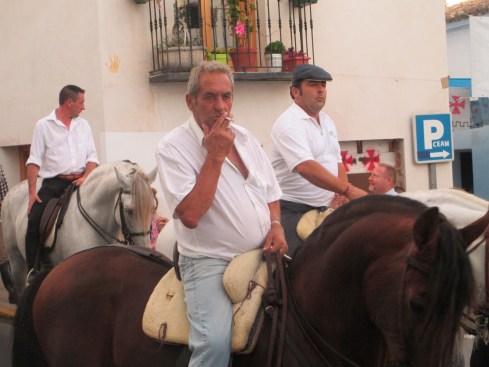
 Although smoking is not allowed indoors, it doesn’t count if you light up while heading for the door.
- Nor does is count if you stand in the doorway and smoke.
- You can stand at the outside window counter of a bar/restaurant designed for serving people outside, and while facing the inside, blow smoke inside.
- You can smoke in an outdoor restaurant patio, even if enclosed or babies/children are present.
- You can hold your baby or child while smoking.
- You can throw your lit cigarette into the street when finished, regardless of whether you are walking, driving, or are on your third or fourth floor home balcony.
- You can publicly smoke at your job.
- You would rather sit outdoors so you can smoke, even in inclement weather.
- Don’t worry if your smoking bothers anyone else.
- You can smoke outside the gym door before and after exercising, and if you need a smoke break during your workout.
- Buy household items that can be used both as vessels for serving food and as an ashtray.
![IMG_0398[1]](https://starrtreks.com/wp-content/uploads/2015/03/img_03981.jpg?w=300&h=225)
Cups that can be used to serve food such as allioli (Spanish version of aioli) or can be an ashtray. I’m not kidding. See the four protrusions on top designed for putting cigarettes when vessel is empty.
Archive | Tapas RSS feed for this section












![IMG_0371[1]](https://starrtreks.com/wp-content/uploads/2015/03/img_03711.jpg?w=300&h=225)
![IMG_0370[1]](https://starrtreks.com/wp-content/uploads/2015/03/img_03701.jpg?w=300&h=225)
![IMG_0367[1]](https://starrtreks.com/wp-content/uploads/2015/03/img_03671.jpg?w=300&h=225)
![IMG_0354[1]](https://starrtreks.com/wp-content/uploads/2015/03/img_03541.jpg?w=300&h=225)
![IMG_0357[1]](https://starrtreks.com/wp-content/uploads/2015/03/img_03571.jpg?w=300&h=225)
![IMG_0400[1]](https://starrtreks.com/wp-content/uploads/2015/03/img_04001.jpg?w=300&h=225)
![IMG_0403[1]](https://starrtreks.com/wp-content/uploads/2015/03/img_04031.jpg?w=300&h=225)
![IMG_0408[1]](https://starrtreks.com/wp-content/uploads/2015/03/img_04081.jpg?w=300&h=225)
![IMG_0409[1]](https://starrtreks.com/wp-content/uploads/2015/03/img_04091.jpg?w=300&h=225)



A Fulfilling, Less Stressful Life Running an Artsy Bar in Idyllic Altea Spain
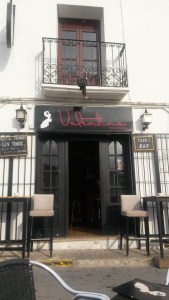
7 JunSara and David at their artsy bar in Altea
In the same week, Sara Wilson lost her job as a staff writer for a major business magazine, and her husband, David Fernandez, lost his position as a private chef for socialites in New York City. They used that as a springboard to “re-examine our careers and quality of life.” They originally met in France, married and moved to California, then to New York to further their careers. Even though they liked certain aspects of living In New York, their lives were stressful, too money driven, and they didn’t get to spend much time together. Sara reflected, “Life gave us solution when we got laid off within a week of each other.” After considering their options, they initially decided to move to more relaxed Spain with the idea of opening a restaurant with David’s father. When that didn’t work out as anticipated, Sara and David started exploring other options, and eventually settled on opening a bar and eatery.
Sara reported, “My six years at the magazine job interviewing entrepreneurs helped us in the process of starting our business.” She added, “Ironically, I learned from people’s stories and their tips for success.” David had previously completed culinary training in Paris. She noted, “David is more of a visionary and risk-taker than I am, but it was our joint talents that helped us develop a successful business.”
Picturesque and historic Altea
They spent several months exploring towns in the Costa Blanca area along the Mediterranean. They briefly looked at touristy Benidorm, but it did not possess the attractive and friendly location they were seeking. Then, “Unexpectedly we encountered a village paradise…called Altea,” recalled Sara. “We loved Altea’s stunning coastline, white pebble beaches and inviting and tasty restaurants lining the promenade.” But it was when they entered the old town, once a fortress, that they were really “awestruck. We loved its picturesque, narrow, pedestrian streets, punctuated by small artisan shops, that lead up to the hilltop church plaza.” Thus they set about on finding a place in the old town, known as Casco Antiguo.
Not long thereafter, they found an apartment and a place to start their dream business, a café/bar which was promoting various forms of art. “The rent was the cheapest we had found, and was the right size for just the two of us to run.” It consisted of two floors that had been transformed from an old house. We liked the fact that it had a mezzanine, a decent stock room, it was just one street down from the church plaza, and was on one of the most charming streets of Altea.” The business had been operating primarily as a sports bar, with a focus on the arts, as well, hence the name AlteArte. Importantly, “The bar already had a local clientele.”
They bought the business, but not the building. Sara stated, “We had been warned that it was important that the business have an existing business license. Just as we were ready to finalize the purchase, we learned that AlteArte did not have a business license.” The owner had applied for it and it was reportedly in process for a substantial period of time, (not unusual with the Spanish bureaucracy), but it had never been completed. Once the owner was aware that this unresolved issue was holding up the sale, the license was quickly approved. Sara and David speculated that the business license application was likely languishing with the local authorities, and that the owner, who was a local native, got the process completed quickly. Sara said, “It helped to buy a turn-key business, with an established clientele.” The prior owner, who sold them the business, wanted Sara and David to be success, and was supportive in a variety of helpful ways.
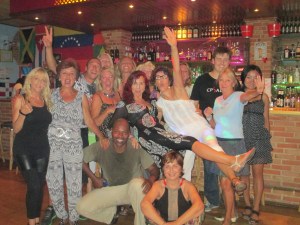
Typical evening with friends at AlteArte
Sara and David “wanted to change the ambience to a cozier environment, which we did by adding tables and changing some of the décor.” They later hung their now iconic multi-colored bicycle upside down from the ceiling, and added some other kitschy design elements. They provide Wi-Fi, and show major soccer matches (“fútbol”). “By changing things, we lost some of the former clients but gained others.” During their first year in business, they were often complimented on their tasty mojitos, so they decided to make that a focus. They setup an increasingly growing mojito menu, and identified AlteArte as a “mojiteria,”which set it apart from the other bars. They also make “nojitos,” alcohol-free mojitos. Adapting to client demonstrated preferences, “We abandoned our early idea of making it a coffee-centric business, instead focusing on our excellent selection and preparation of teas,” in addition to other typical bar beverages. Although their service focus is primarily on beverages, they also have a small selection of tapas and quesadillas, the latter being a popular, but rare item in Altea.
Casco Antiguo in Altea
Asked if they have encountered any problems or challenges in setting up their business, they reported initially the neighbors complained about noise and the tables and chairs they had placed on the stairs adjacent to their building. “Eventually, we were able to make peace with the neighbors, after convincing them that we would keep the noise down, and not cause them any problems.” During the slow time of year, they do minor renovations to AlteArte, but they noted it is hard to find qualified people who complete the work in a timely fashion. After deciding to start their business in Altea, Sara quickly began learning Spanish, something she felt essential in running their business.
The owner of their building had been renting out the top floor to various people as a shop with touristic and artisan items, but after a series of several failed businesses there, he asked Sara and David if they were interested in adding the top floor to AlteArte. “We decided to take this opportunity to expand. The top floor is primarily for special events and gallery exhibits, as well as weekly intercambio (Spanish English language exchange.)” AlteArte exhibits “one or two artists’ works each month.” The middle floor is an inviting area with pillows and populated with board games.
“The customers, new and old, shaped AlteArte’s atmosphere by natural evolution.” They have about an equal percentage of local and expat customers, with “most ex-pats in this area of the Costa Blanca area of Spain being Scandinavian.” In the beginning, most of their clientele came through word of mouth and Facebook. After opening the gallery on the third level, we reached out to local newspapers and magazines to promote those events.”
After they first opened in February 2010, Sara and David ran the business by themselves. “During our second and third summer, we hired our first employees. In our fourth year of operation, we hired Emily as our first full time employee. She had been a patron, and she had a good work track record of seven years at one local restaurant.” They emphasized it is very important to check out the reliability and work history of potential employees in Spain as there are generous laws favoring them, such as being allowed substantial sick leave just after being hired. A few months later, they hired another young woman, Ampy, full-time. Both employees are friendly, competent, and able to communicate with the clients regardless of what language they speak. “We pay them a little more than the typical local wage, and uncommonly, we also give them one day off a week including during the busy summer months.”
Sara and David inside AlteArte
When asked about other start-up or ongoing expenses or requirements, “there was an initial food safety course, basic business insurance, and nominal annual taxes.” They have not had any tax liability in the United States based on their Spanish net income. “We recommend using a gestoria,” which is a person whose task is to deal with the idiosyncrasies of Spanish government departments, for paying complex fees and taxes. “We receive an annual visit from the health department to check for correct refrigerator temperature and proper sanitation.” With regard to promoting AlteArte, “We have done some marketing by advertising our business in local tourist maps. Because we are in the Old Town, which is a steep, historically-protected area, we are not required to have handicap accessible facilities.” Sara reported, “AlteArte has allowed us to cover all of our expenses including the luxury of having two employees” which affords Sara the opportunity to spend long visits with her family in California. This year she has had two separate one-month visits with her family. AlteArte has given David, now 40, and Sara, 37, “a more comfortable, and significantly less stressful lifestyle than at our prior high pressure jobs, and the opportunity to spend more quality time together.”
When asked what advice they would give to others considering opening a business in Spain, they recommend, “Be patient and committed.” They said, “One cannot expect to open a business just for a summer, and turn a profit.” They also stated it is important to understand the demand for the type of business one is considering, and the required permits if starting from scratch. “It is also essential to have enough capital for start-up costs, slow periods, and unexpected expenses.” Sara said, “I’m kind of glad I didn’t know before we started how many businesses end up closing down.”
Now celebrating over six years of operation, AlteArte, is a favorite with local ex-pats, Spaniards, and international travelers. They feature monthly art exhibits by local artists; a book club for which Sara often arranges for the author to be present in person or remotely; live music; weekly Spanish-English language exchange (intercambio); movie nights, craft, drama and dance workshops, cooking competitions, and many more. Asked about her most cherished memory, Sara quickly reported it was when director Eugenio Mira, an Altean native, chose to premier his movie Grand Piano at AlteArte, and afterwards had a question and answer session.
Retiring to a Fun, Inexpensive, Quality Life
20 Mar
Altea on a rare cloudy day
Today I got up at the crack of noon. It’s not something I do every day, but it is a luxury I relish after those late Spanish nights out with friends. Yesterday, I had two Norwegian friends over to my house for a traditional American dinner, something they asked if I would do. Here in Altea, in the Costa Blanca area of central Mediterranean Spain, it is sometimes difficult to source some typical American food ingredients, but it makes for a fun challenge. When I wanted to make authentic Jamaican Jerk chicken and could not find habañero peppers, David, a chef and co-owner of my favorite local bar, AlteArte, volunteered to buy some for me at a commercial food market for restaurants. AlteArte is a local mojiteria (bar specializing in making mojitos) and arts bar.
After our American dinner, Daniel, one of my invited guests, was hosting his monthly movie night at AlteArte, so we took the short walk to it in the center of the historic old town at the top of the hill. We stayed late enjoying the busy, convivial atmosphere. The prior week Daniel had me to his house for a traditional Norwegian dinner. Both he and his roommate each created their unique regional specialty dishes. Being from north of the Arctic Circle, Daniel’s dish was roast pork with crackling skin. Delicious! I love the opportunities to meet new friends with whom I can exchange our different cultural traditions. Another particularly memorable experience I have had was when a Nepalese family invited me to their house for a delicious, homemade meal at their home. It was my first time eating traditional, homemade Nepalese food, and afforded me the opportunity to get to know more about their lives and culture in Nepal.
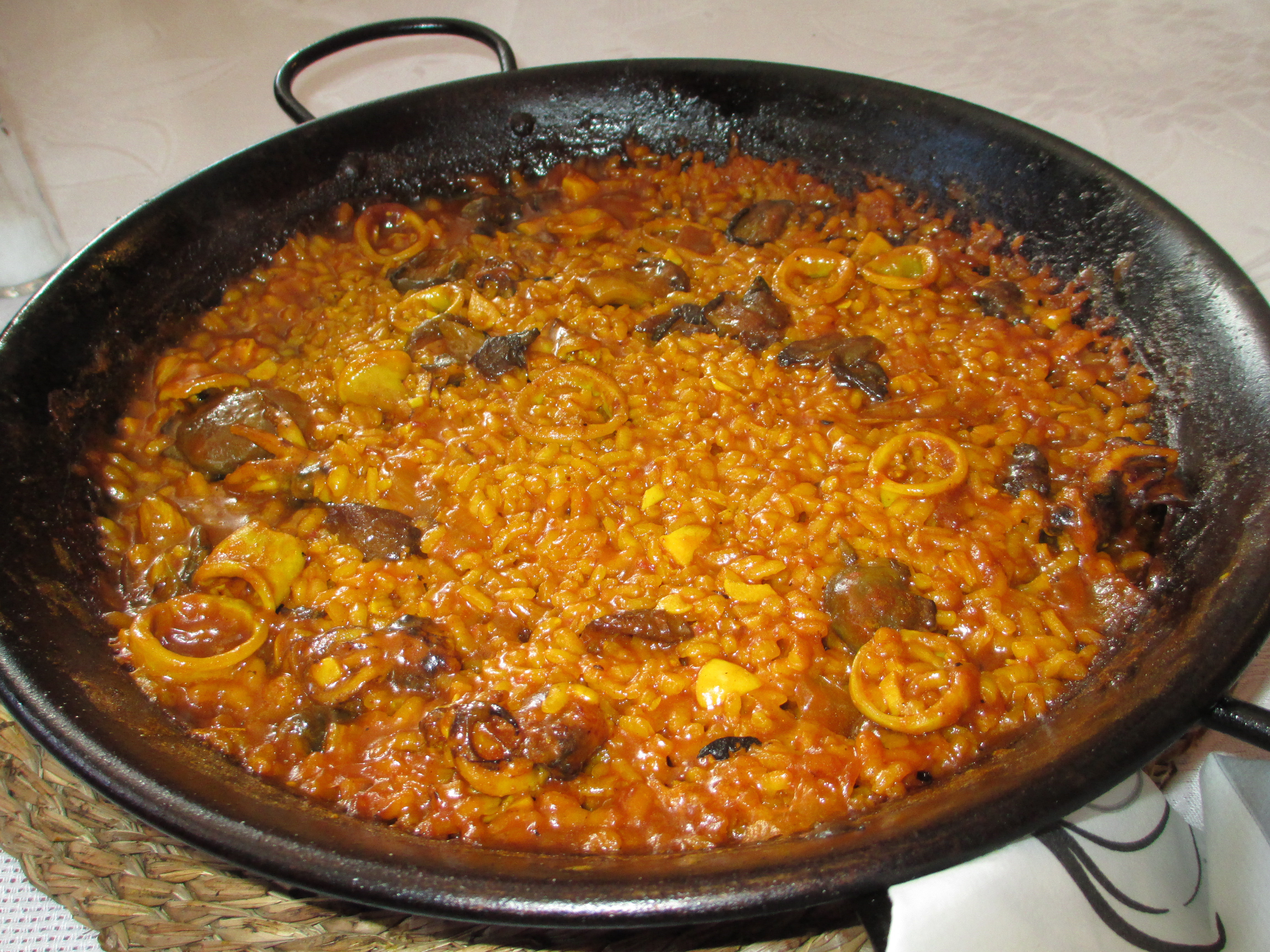
Seafood paella
There are always challenges when trying to re-create and share American traditions to my friends in my new home country, Spain. However, mostly I embrace the new cultural and food customs here. Jamones (various types of ham and pork products) are a Spanish favorite, served simply as thin slices or often as an ingredient in many dishes, like steamed clams with pieces of ham. I have even found ham in the usually vegetarian gazpacho blended soup and in steamed clams. There is an incredible bounty of fresh fish and seafood from the local Mediterranean. I enjoy spontaneous daily forays to local bars where, in the evening, I get a free tapa with my glass of wine for as little as 1, 20€ ($1.32.) Inevitably, I encounter friends with whom I enjoy genial conversation.
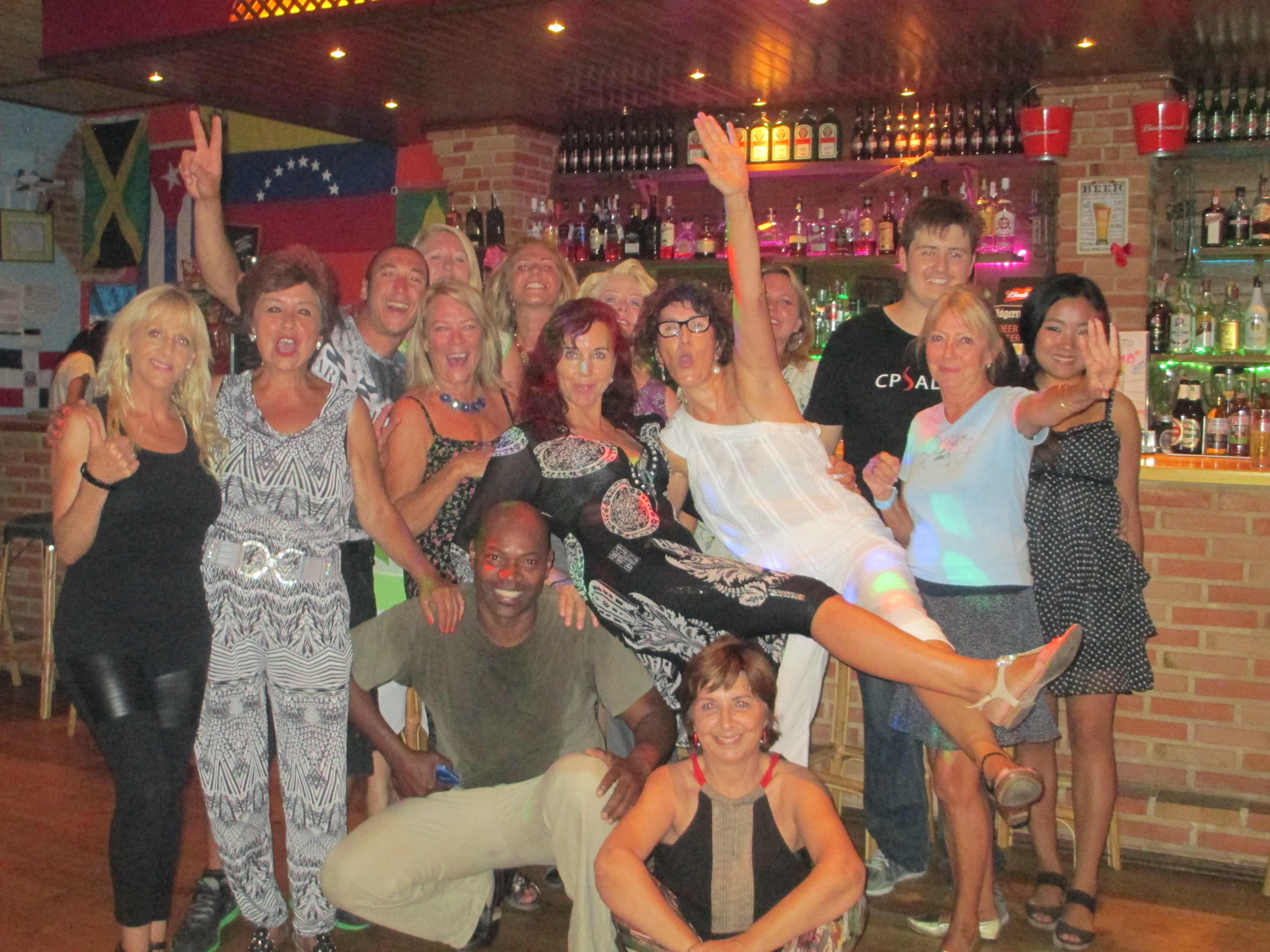
Bar Cuba
Although I was an avid live music fan when I lived in the Central Coast of California, here in Altea Spain, there are many diverse activities, including the many regional Spanish festivals, live music, in addition to the time spent celebrating new cultural experiences with friends. One of my regular favorites is going with friends to Bar Cuba, for salsa and other types of Latin dancing to live music by Rafa, a friend who is originally from Venezuela. Bar Cuba is co-owned by Raúl and Nikki; Nikki is a friendly, competent businesswoman who originally hails from Jamaica. Other nights she schedules salsa and other Latin dance classes, karaoke, televised soccer games (fútbol), and specialty international dinners. Living in Spain allows me to enjoy traditional Spanish festivities, as well as experience cultural experiences from the variety of ex-pats who live here.
With the low cost of living in the Costa Blanca, I no longer have to work, and can focus on friends and fun. The Spanish are known for their many festivals, which offer spectacle and fun. Where I lived in California, it was nearly impossible to function without a car.

Moros y Cristianos festival
Here in Spain, I relish no longer having to have a car. I walk to all of my local activities, or take convenient, efficient, inexpensive public transportation to nearby towns, with unexpected health benefits. Instead of finding it difficult to even arrange a short monthly get together with a friend in California, here in Altea, rarely does a day go by where I don’t meet up with friends, whether planned or spontaneous. It is sometimes hard for me to believe that I live in one of the most beautiful villages in Spain, with such an inexpensive cost of living, and fulfilling quality of life.
Visual Collage of Altea Spain This Week
29 Mar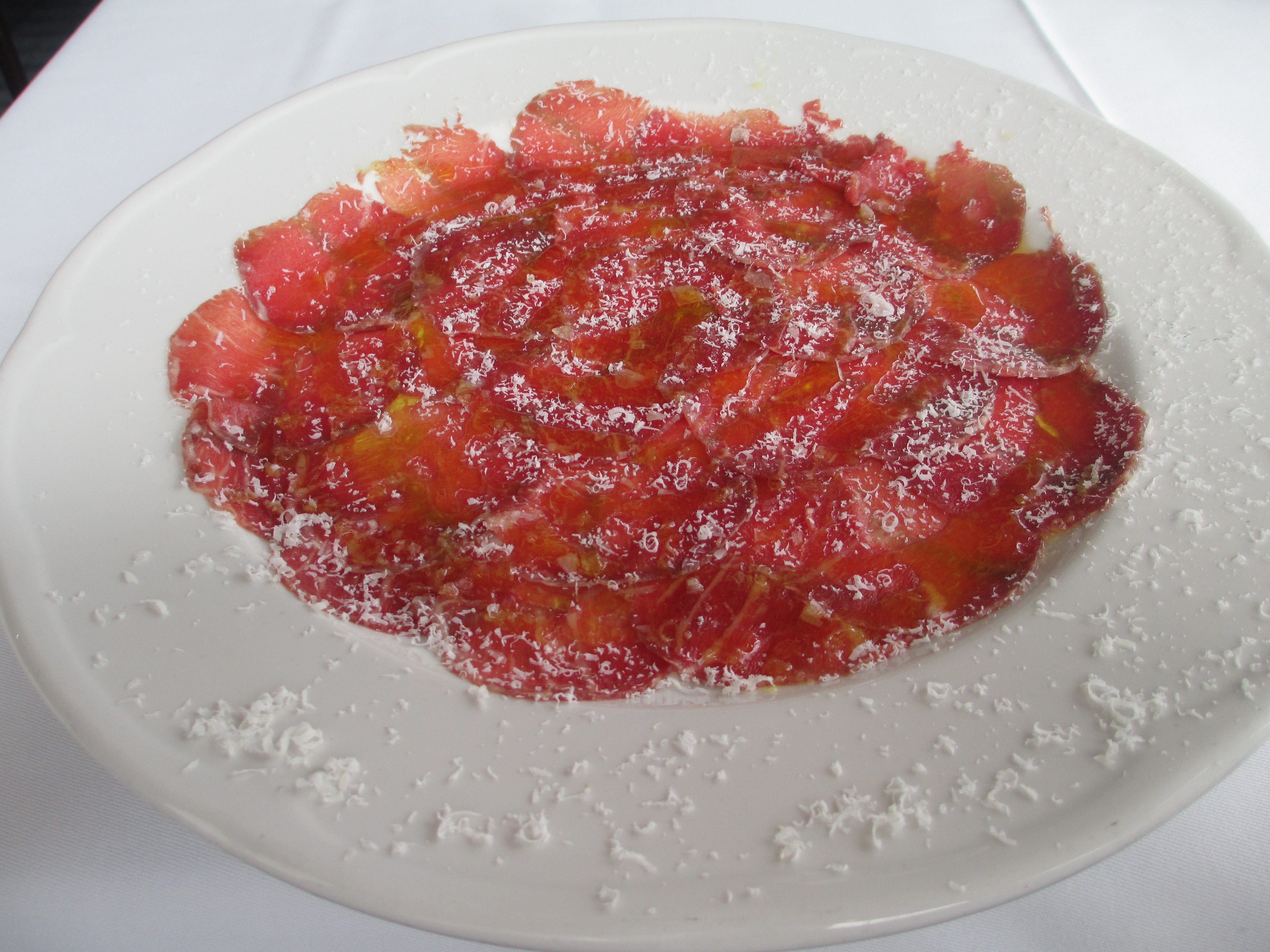
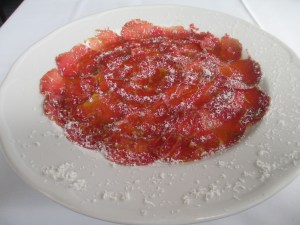
Carpaccio: El Bodegon de Pepe
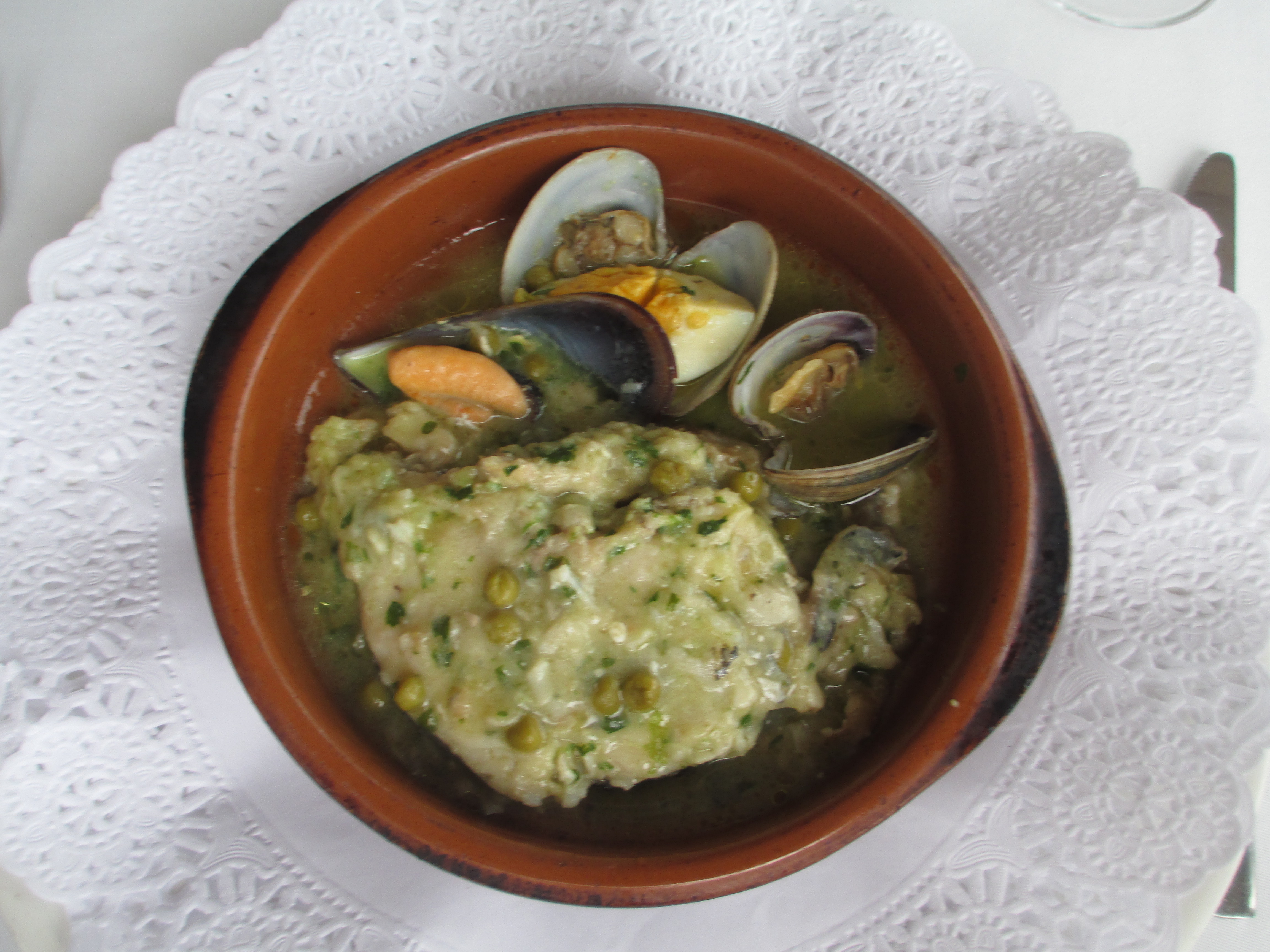
Fish with mussels and clams

Tapas at Playa Fronton

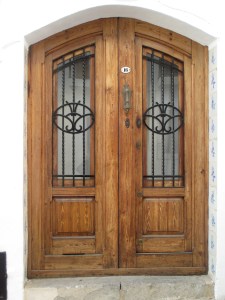
Door on Carrer Sol

Ensalada mixta
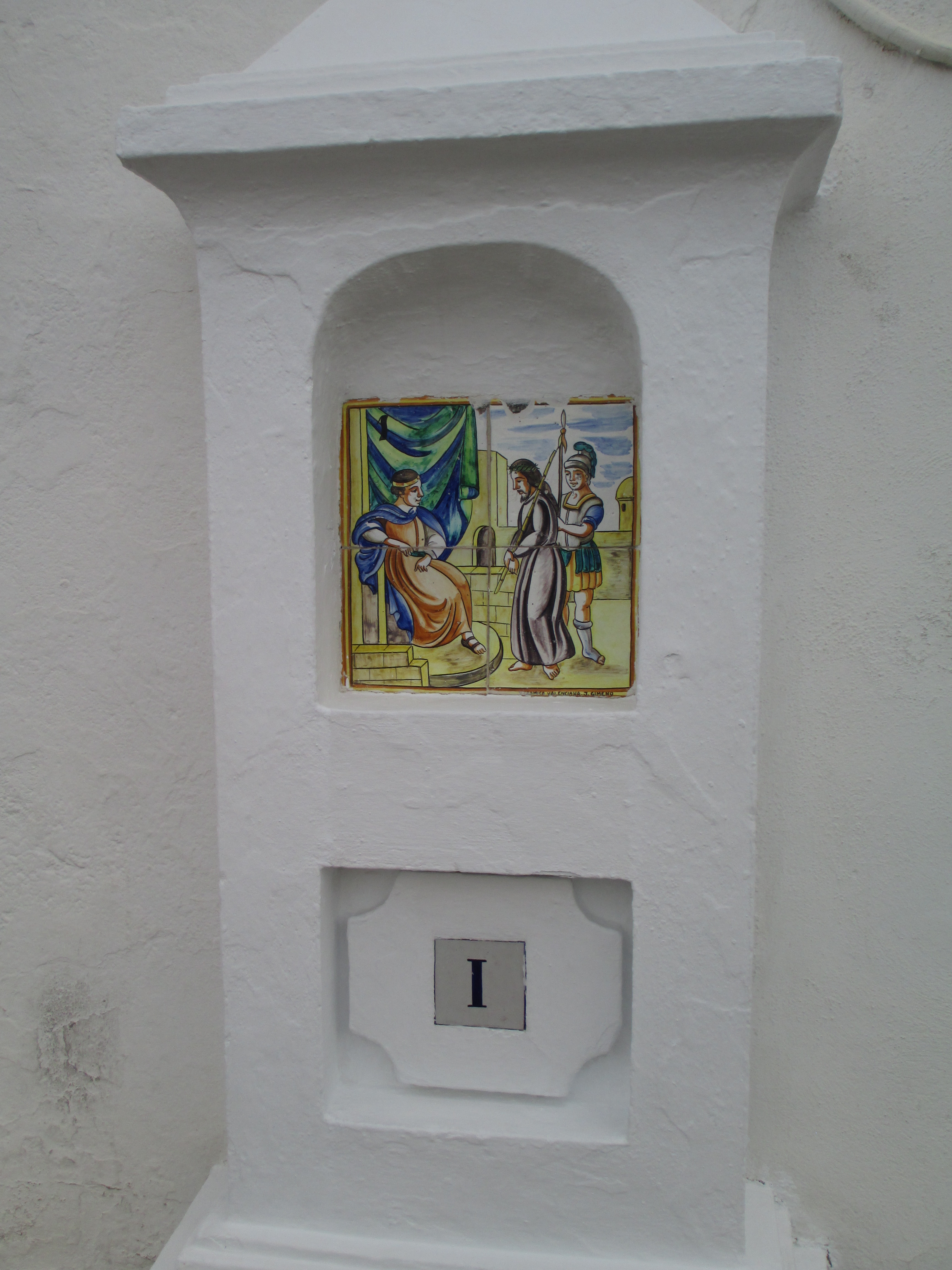
First station of the cross
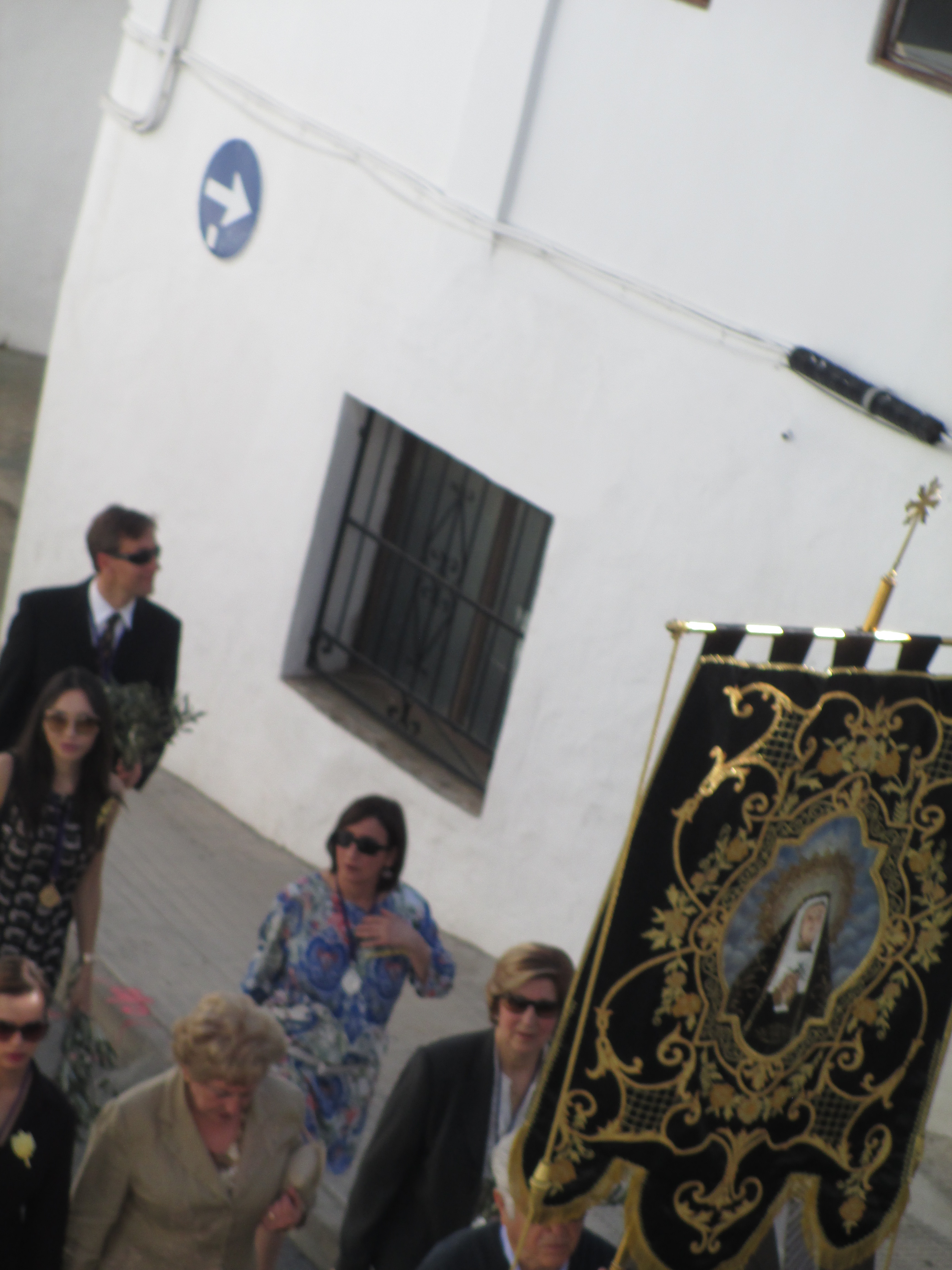
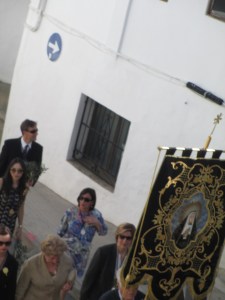
Part of Palm Sunday procession from my apartment window

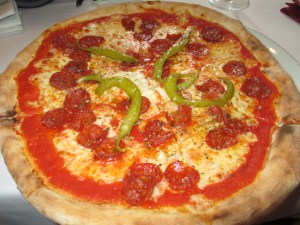
El Castell pizza: best in Altea

View of Casco Antiguo from my friends’ Barry and Karen’s apartment
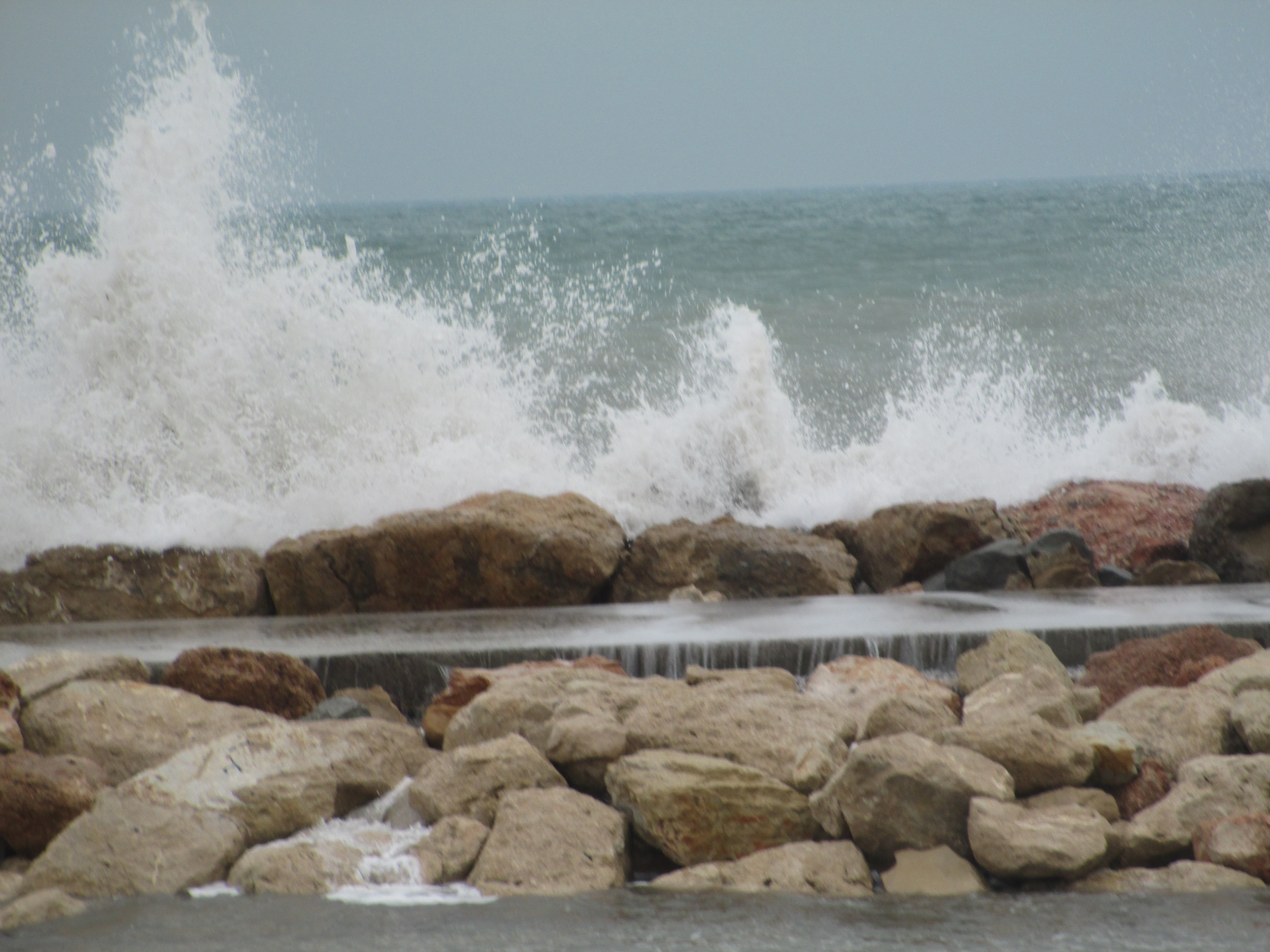
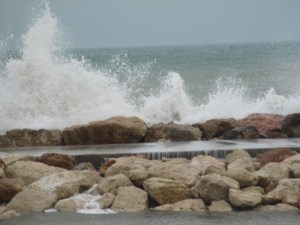
High waves on windy day
Party…Spanish style!!
19 Mar
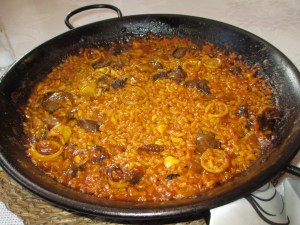
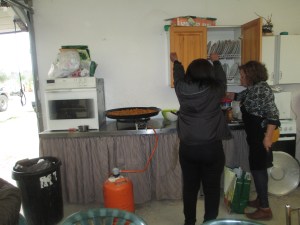
Party paella being prepared
Yesterday was a stellar day in that I was invited to the birthday fiesta of the “novio,” (boyfriend) of my good friend, Carmen, whom I have known for about a year. She came to Altea about a year ago, and now lives with Pepe in the adjacent town of La Nucia. Since La Nucia is slightly inland, the houses are more likely to be single-family detached homes, often on large plots of land in the undulating countryside which harbors fruit trees and other vegetation, horses, and other scenic pastoral sites. Although very close to my town of beachside Altea, it has considerably different feel.
Since I (proudly) no longer own a car, Pepe picked me up and drove to his “estancia” (ranch.) En route, he explained that he lived in Altea when he was young, but has been living in La Nucia for 40 years. Upon arrival, he gave me a tour of the house, outbuildings which housed two separate barbecues, and many fruit trees. I laughed as I recognized that the blue granite counters he had in his kitchen were the same as I had installed at my former house in California.
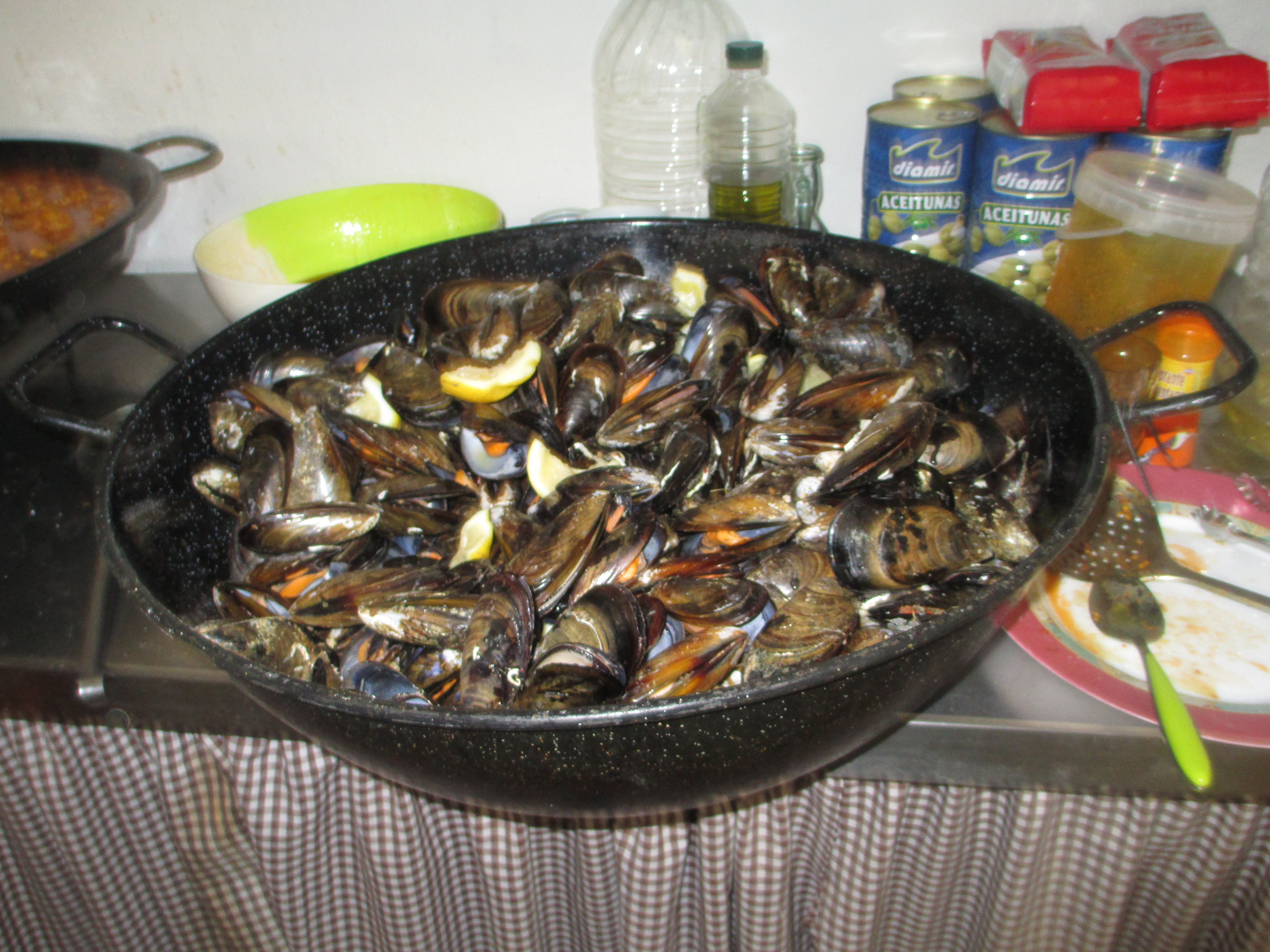
Mejillones (mussels) being cooked
Carmen, who is Cuban, was busy cooking dishes from her nascent land, including rice with black beans, pork (which had incredibly crispy delicious skins), and “tostones” (fried plantains.) Although I am not usually a fan of plantains, these were excellent. I watched as she pounded them a little flat and then fry them in oil. I rescued one batch from burning when she left the room to greet some newcomers. The following day (today as I write this,) when we spontaneously met for lunch and I told her how much I liked them when I usually don’t, she said she first soaks them in vinegar.
After her cooking creations were bundled for transport on party day, we took the short drive up the hill to the large outbuilding where the fiesta was to occur. Typical of this area, were two huge pans, one of paella and the other of mejillones (mussels) being expertly prepared by two local women. Paella, after all, is originally from Valencia, and Altea is part of the Communitat Valenciana (as they say in the local Valenciana dialect.)

Carmen helping with the party preparation
Of course, there were the typical cheeses and cured meats available, with loaves of fresh baguettes (as common here as on my many trips to France,) free-flowing wine and beer. With the mussels and paella, several large mixed salads lightly dressed were served in the middle of the lengthy table.
The promise of Cuban music for dancing was frustrated by the lack of cooperation of the equipment brought for that purpose, but Pepe backed up his car to the large open doors of the building and cranked up his Cuban tunes. Rei, a local salsa teacher, got (almost) everyone up shaking their groove things. The multi-cultural assembly including locals, Columbians, Cubans, a Norwegian and others made for a great experience including the chance to practice my Spanish and find new dance friends for the weekly Sunday Cuban/salsa music at Club Cuba in nearby Albir.
Toward the end of the birthday party, they served what was the best dessert I have ever had, and even one of my best desserts ever (although I am not much of a sweet eater.) It was vanilla custard between layers of thin, crispy puff pastry like a mille-feuille (Napolean) but with fresh fruit on top. As it was time to leave, leftovers and lemons from Pepe’s trees were offered to take home. I was driven home with my large, gorgeous lemons in hand, feeling utterly happy with my new life in Spain. Unfortunately, my photos do not reflect the full revelry of the day as my camera battery crashed but what few I got are shown here.
More Food Porn from Altea Spain
15 Mar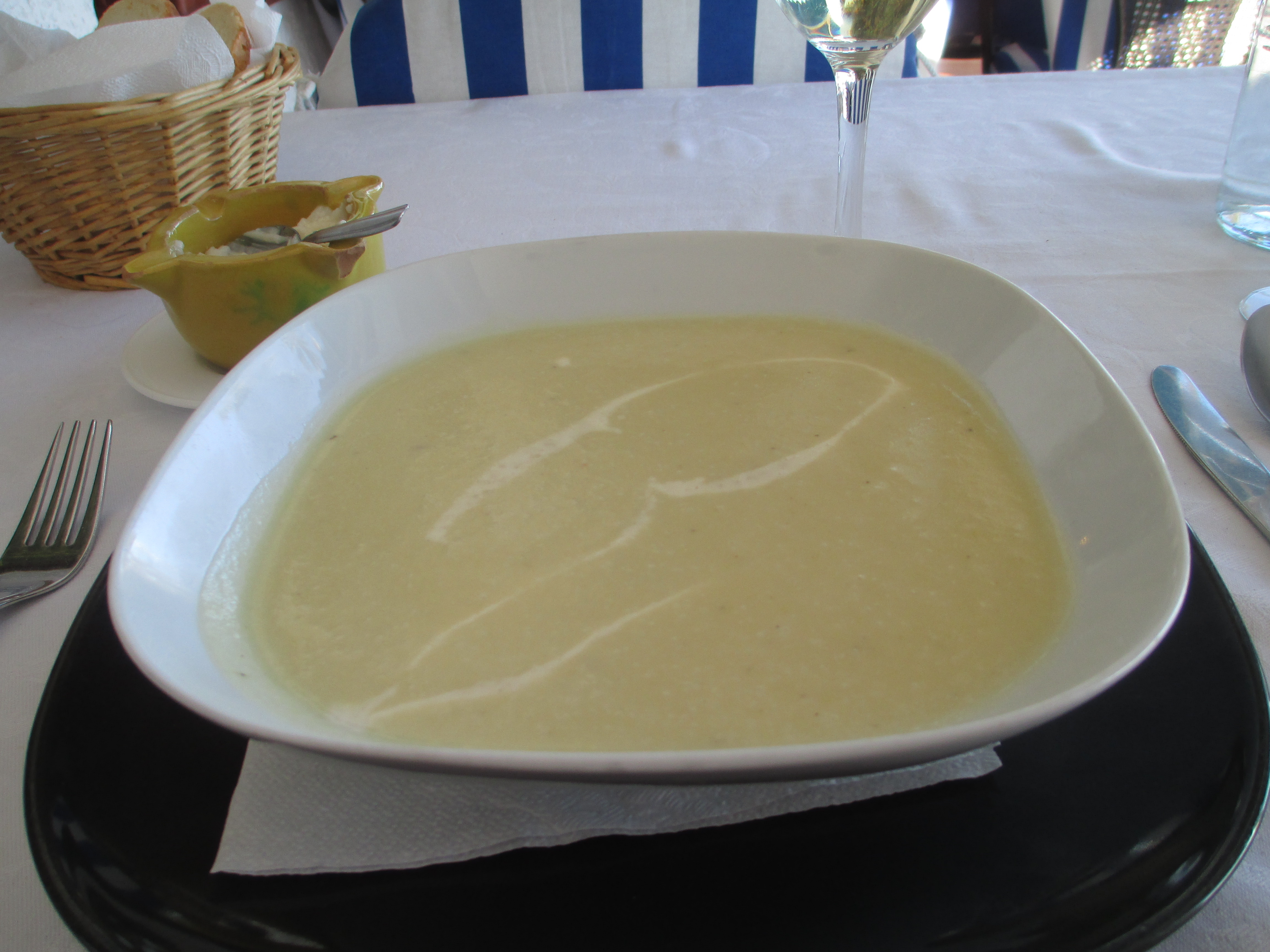
Sopa de puerros (leek soup)

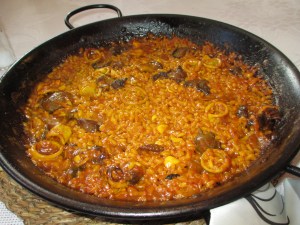
Paella con bandas (paella with calamari)
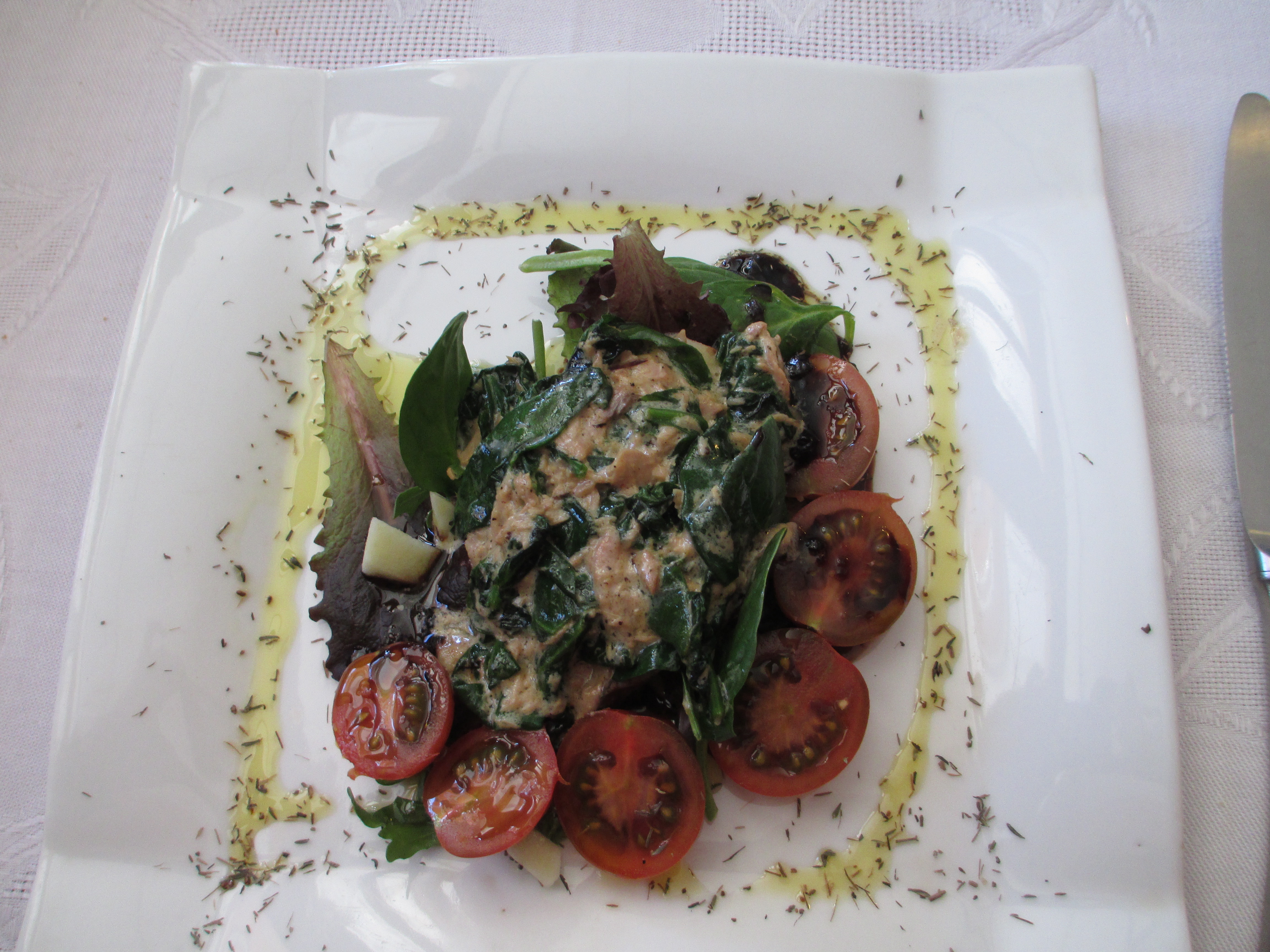
Enselada de tomates (salad of tomatoes)

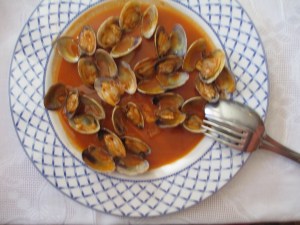
Almejas marinera (clams mariner-style)
![IMG_0371[1]](https://starrtreks.com/wp-content/uploads/2015/03/img_03711.jpg)
Alcochofas a la parilla (grilled baby artichokes)
![IMG_0370[1]](https://starrtreks.com/wp-content/uploads/2015/03/img_03701.jpg)
Enselada de puerros con jamon (Leek salad with ham)
![IMG_0367[1]](https://starrtreks.com/wp-content/uploads/2015/03/img_03671.jpg)
Tripa en salsa (tripe in sauce)
![IMG_0354[1]](https://starrtreks.com/wp-content/uploads/2015/03/img_03541.jpg)
canonigos, huevos con queso y jamon (cononigos (round green leaf herb), eggs with cheese and ham). Also typical bread served with grated tomato with olive oil
![IMG_0357[1]](https://starrtreks.com/wp-content/uploads/2015/03/img_03571.jpg)
rabo de toro (oxtail)
![IMG_0398[1]](https://starrtreks.com/wp-content/uploads/2015/03/img_03981.jpg)
pan y alioli (bread with Spanish version of aioli which has no egg). Note the container for the alioli can also be used as an ashtray. More about that on my humorous look at rules for smoking in Spain to be posted soon.
![IMG_0400[1]](https://starrtreks.com/wp-content/uploads/2015/03/img_04001.jpg)
Chopitos (fried small baby calamari)
![IMG_0403[1]](https://starrtreks.com/wp-content/uploads/2015/03/img_04031.jpg)
lenguado meuniere (sole meuniere)
![IMG_0408[1]](https://starrtreks.com/wp-content/uploads/2015/03/img_04081.jpg)
Sole meuniere “after.” Don’t be afraid to tackle eating or cooking a whole fish!
![IMG_0409[1]](https://starrtreks.com/wp-content/uploads/2015/03/img_04091.jpg)
Flan (a rare time I ate dessert)

It was a dark and stormy night…
Adventures in Dining in Altea Spain
13 Mar
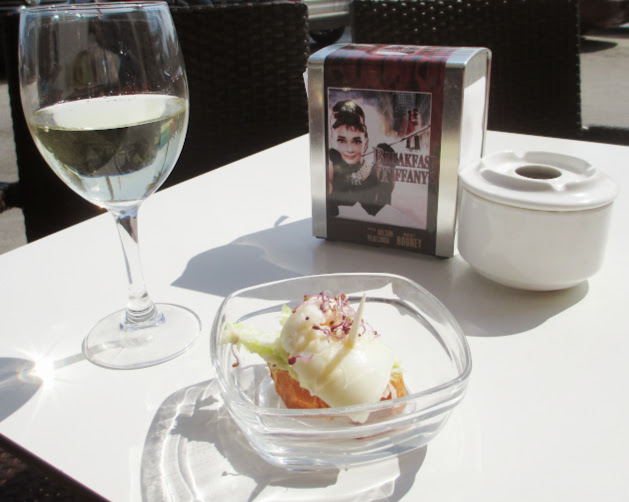
Tapa with egg and garnish 13 Mar ’15
“Pigs ears?” he asked in Spanish, apparently to be sure I knew what I was ordering when I pointed to one of the tapas trays. I admit I wasn’t 100 percent sure what they were when I ordered them, but every tapa I had ever eaten at beachside Fronton Playa in Altea (Spain) was spectacular. I grew up eating my fair share of offal, so I am game for trying just about anything. On this particular visit, I decided to order a couple of tapas, so I could get more than the typical small tapa bites. Along with the pig ears, I had some small breaded and fried octopus “pulpo” tentacles, which were tender, which is not always the case at many local eateries. The friendly owner reminds me of Danny Devito. On most visits, I order a “vino,” which is accompanied by a creative, tasty tapa, which is included in the inexpensive 1,50 € 

Valentina in Casco Antiguo
Valentina is another of my favorite tapas places where I have had interesting food forays. Andrea and his family hail from Puglia (Italy), but have lived here in Spain for many years. Andrea’s girlfriend, who is the chef, makes creative and delectable food. On one occasion, a darling two-year old girl repeatedly chanted, “Caracoles,” as she waited for the small snails to be prepared and served. She ate them like a pro. On several occasions, Andrea has brought me a tapa that he would not serve to everyone. One memorable tapa was something with a texture similar to tofu but with a meaty taste, saying he knew I would eat it. When I inquired as to what it was, he smiled and replied coagulated chicken blood. My son, Robbie, an executive chef in at Belcampo, a well-reviewed restaurant in Los Angeles specializing in their own humanely and sustainably raised animals, asked me to find out how it was made. 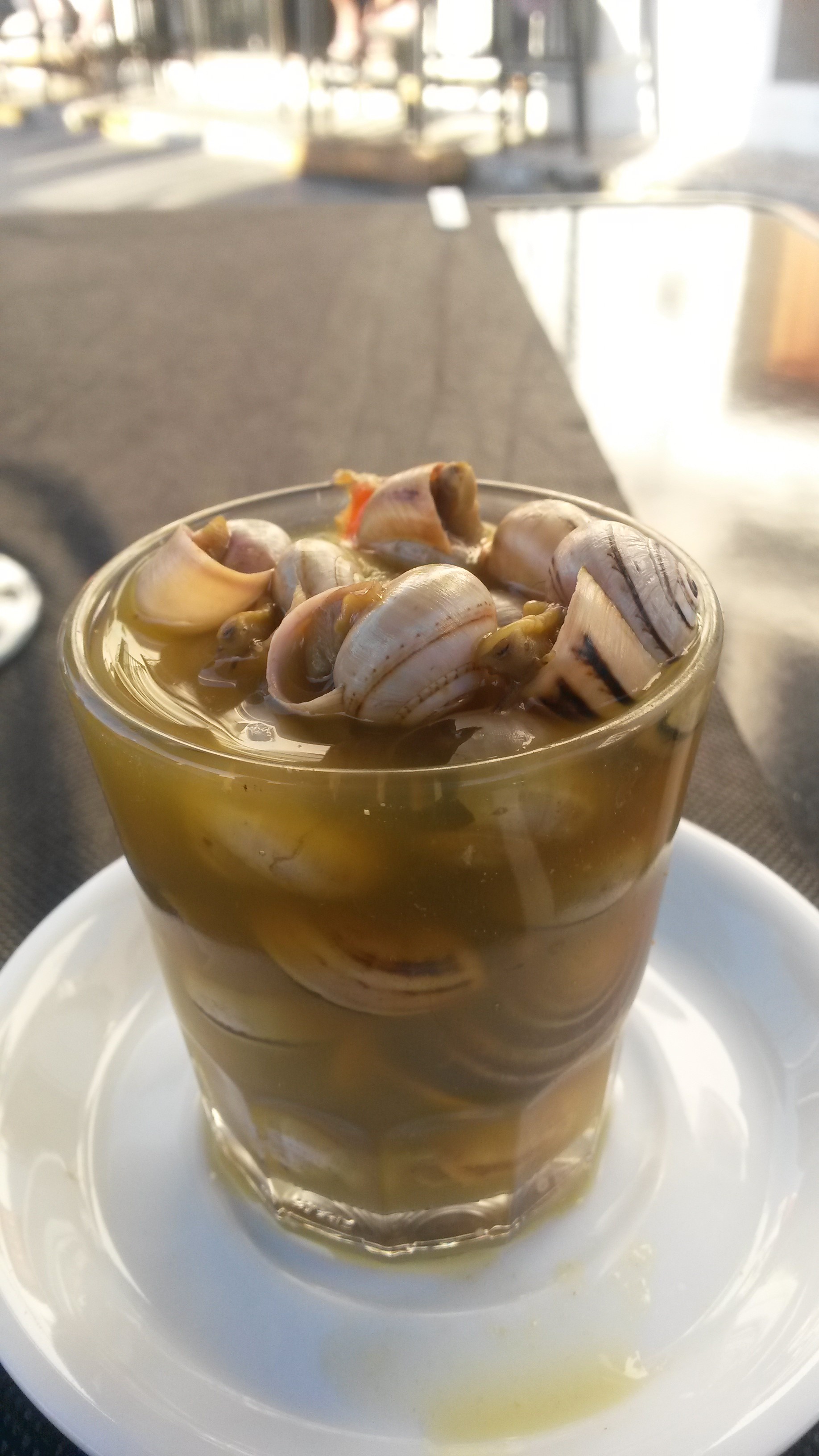 On one of the occasions I ordered something from the menu I had “Milhojas de pulpo y gula del Norte,” octopus with baby eels.
Dining in Spain is almost always a great adventure. I am an avid fish and seafood lover, and there is seldom a day that goes by when I haven’t had several of the many creatures available in the local Mediterranean waters. I am constantly trying new items from the sea including things we may have one of in California, like calamari. Here the calamari are large rings, about the size of onion rings, and often cooked by breading and frying. I find them too tough. Then there are “chopitos,” whole baby calamari with ink sacks intact, which are best when fried with a light almost-panko like crispness. Sepia is a cousin of sorts of calamari, which is larger and thicker, and is often grilled and served with a green “marinera” sauce, mariner’s sauce, not to be confused with the Italian tomato sauce, “marinara.” I have found some foods to not be worth the effort involved in trying to eat them. After a recent intense Zumba class, I went to a local tapas bar, regularly patronized by cordial smoking, drinking “abuelas” (grandmas) and their grandbabies, (and I mean no disrespect but it is very different than when I lived in San Luis Obispo county, California, where they were the first place to outlaw indoor smoking or smoking near food service.) At the café, I was told the grill had been turned off, but the fryer was working, so I ordered “patatas bravas” (spicy fried potatoes, which are not spicy if someone eats habanero sauce like I do), and fried fish. Note to self: check the type of fish before ordering. They were sardines and other equally small fish, which with my knife skills, yielded few consumable morsels. And the incredible number and quality of bivalves! Almejas (clams), berberechos (smaller clam-like content, with a scallop taste), the itsy bitsy tellinas (too much work), razor clams, mussels, oysters, gooseneck barnacles, and more.
The grocery markets are filled with seemingly endless displays of fish and seafood: fresh, frozen, and canned (which are viewed as another great way to access seafood as opposed to American’s frequent opinions that canned food is of suspect quality.) For a foodie like me, the grocery and fresh food markets are intoxicating with their fresh and novel ingredients. As I was photographing the vast displays of fresh fish and seafood at a regular local grocery market, Mercadona, a female fishmonger admonished me from taking more photos. So here I will include a partial sample of the store’s offerings, and the selection of frozen and canned fish and seafood is even larger. (If you read Spanish and the words don’t look familiar, that is because the official language here in the Valenciana Community is “Valenciana,” but more about that surprise to me at another time.) If you look at the trays of fresh items from the sea, it is apparent that many home cooks are adept at using fresh whole fish and other types of seafood.
 I thought I hit the jackpot when I recently walked into a local market and found a beautiful dozen little quail eggs, for 0,90 €, less than the American equivalent of $1.00. On today’s cooking television shows, they showed how to make livers with “sangre” (blood) over a fire in the hearth, and “coda de cordero,” typical recipes from other parts of Spain. The food options here are inspirational, and I am eager for my two boxes of kitchen cooking supplies to arrive here from my former home in California. Those are the only things I had shipped here, (along with a few family and travel) mementos, which speaks to my priorities.
You can find my many restaurant, as well as other reviews, on Trip Advisor, as well as my map of the hundreds of places I have travelled.

View walking home after tapas today
Connect with Me


 Starr Treks