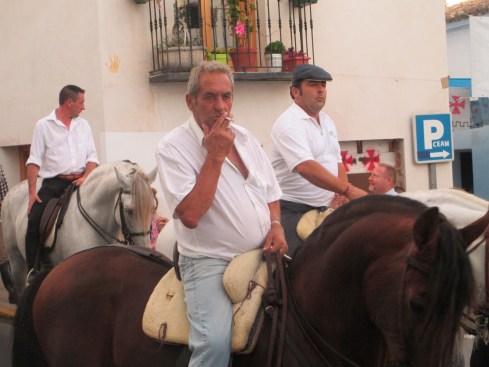
 Although smoking is not allowed indoors, it doesn’t count if you light up while heading for the door.
- Nor does is count if you stand in the doorway and smoke.
- You can stand at the outside window counter of a bar/restaurant designed for serving people outside, and while facing the inside, blow smoke inside.
- You can smoke in an outdoor restaurant patio, even if enclosed or babies/children are present.
- You can hold your baby or child while smoking.
- You can throw your lit cigarette into the street when finished, regardless of whether you are walking, driving, or are on your third or fourth floor home balcony.
- You can publicly smoke at your job.
- You would rather sit outdoors so you can smoke, even in inclement weather.
- Don’t worry if your smoking bothers anyone else.
- You can smoke outside the gym door before and after exercising, and if you need a smoke break during your workout.
- Buy household items that can be used both as vessels for serving food and as an ashtray.
![IMG_0398[1]](https://starrtreks.com/wp-content/uploads/2015/03/img_03981.jpg?w=300&h=225)
Cups that can be used to serve food such as allioli (Spanish version of aioli) or can be an ashtray. I’m not kidding. See the four protrusions on top designed for putting cigarettes when vessel is empty.
![IMG_0398[1]](https://starrtreks.com/wp-content/uploads/2015/03/img_03981.jpg)
Taxi Travel Perils and Moros y Cristianos in Altea Spain
9 Oct
Moros
“The taxi driver wouldn’t follow the directions you provided. He said, ‘Moros y Cristianos’ and ‘impossible,’ then stopped, unloaded our luggage and told us to get out. We don’t know where we are.” This was the first comment from my friend who had just arrived in Altea from California. In addition, the WhatsApp wouldn’t work for her, so I hadn’t gotten any of her prior calls. Having not heard from them at the expected arrival time, I then called her via regular (expensive) international mobile rates, which is when I received her panicked statement.

Camels with Moros
In anticipation of the arrival of my two girl friends from California, I fretted over possible, or should I say probable, problems with the cab driver getting to my apartment during the annual Moros y Cristianos (Moors and Christian) festival. This was not my first problematic experience with Spanish cab drivers. My fear was realized, in spite of spending several days providing a map and writing out the directions in Spanish (and English so my friends could see if he was going the right way.) At the beginning of the directions was the admonition in Spanish (which my friend read aloud) not to go the usual way due to the Moros y Cristianos festival. In response, he simply entered my address into his guidance system, and drove to the starting spot of the parade, at which point he dropped them off on the highway (Carretera 332) that runs through Altea.

Christian fila party across from my apartment
After eventually figuring out where they were, I found them near the start of the Moros y Cristianos parade route. With luggage in tow, we then proceeded to the seats on the parade route a local friend had saved for us. Although I had told them they would be in Altea during the Moros y Cristianos festival, they had no idea of the magnitude and pageantry of it. The festival commemorates the Christians reconquering the areas of Spain that had been conquered earlier by the Moors.

King in the procession to the church plaza from my window
Nor did they anticipate the incredible level of noise associated with most festivals in Spain. In the early morning, there is the despierta (wake-up) when the local filas (brotherhoods) proceed up the hill toward the church plaza while their respective brass bands play and others fire noise-making guns and firecrackers, all the while drinking and smoking. (Having attended the festival for two years, I have only seen one Muslim participate.) Throughout the day, the many filas have parties at their individual sites, with food, alcohol and music. The fila Moros across the street from my balcony, Els Malvins, have a fabulous group of musicians, which I am privileged to enjoy without having to leave my home. In addition, there are many other adjunctive activities such as midnight fireworks, re-enactment of battles between the two groups,

Solemn religious procession
The festival culminates with evening parades, first the Moros, the next day a solemn religious procession, and finally the Christians. After those parades, the filas return to their home sites where they continue to party until the early hours of the morning. In addition, there are live music/dance venues that start after midnight and go for many hours. I don’t know how they can stay awake that long, let alone, party that intensely. Tellingly, on the day after the festival ends, almost all of the local businesses are closed, apparently for recuperation and clean up.

Quail with apple slices, grapes fruit compote
My friends were thrilled with the Moros y Cristianos festival, as well as many other aspects of Spain, including the friendly international locals, the many varieties of activities, day trips to other towns, fabulous food and the ambience of beautiful Altea.
Adventure to El Campello
3 Sep
Enjoying Xiringuito Ton-Tin with Sandie Sheppard
With so many interesting places and events here on the Costa Blanca in Spain, I have decided to start taking short trips to some of these spots. Serendipitously, I met a woman at a local jazz fusion concert, who also is a live music fan. While we shared a table, I was expressing my frustration about the difficulty finding information on the internet about live music venues. She then volunteered that she knew several live music venues and offered to send me the information.
Xiringuito Ton-Tin in El Campello, just north of Alicante, was one of the locations she recommended. During July and August, they offered daily performances every evening. The day we went the saxophone and trumpet players were featuring jazz, soul, bossa nova, and swing. The two musicians were fantastic. A few people danced, but at other events there seem to be far more dancers. Xiringuito Ton-Tin features a wide variety of music genres, and will continue to have live performances in September. It is located on the beach, with the seats and tables and large globe-shaped white lamps, all situated on the sand, which we loved. For those unfamiliar, Xiringuito, also spelled chiringuito, is typically a small beachside business where one can get beverages and snacks. Many times they are only seasonal summer spots. Xiringuito Ton-Tin regularly posts their calendar of events and video excerpts of concerts. Reservations are recommended as many tables were booked in advance.
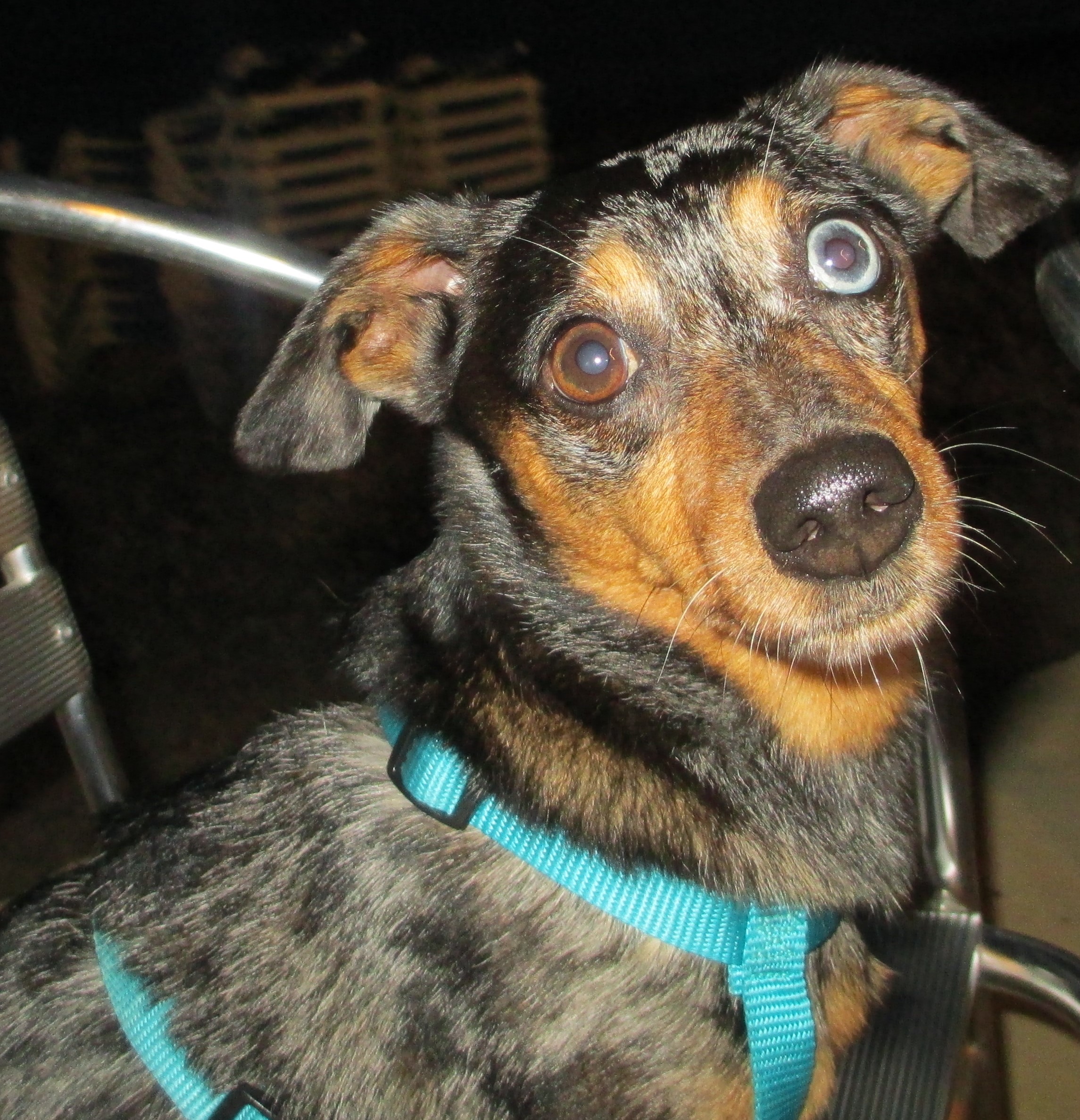
Pepper at a concert
To get there, we took the tram from Altea to El Campello, which took a little over an hour. I brought my little dog in a wheelie back-back, although I have gotten inconsistent information on whether pets are allowed, so I just placed the backpack in a position between my legs where no one could see what was inside. When we arrived, we ate at a local restaurant across the street from the ocean, and a very short distance from the tram station from which we exited. I only booked the trip the day before we left, yet still managed to find a reasonably-priced hotel that was pet-friendly in nearby San Joan d’Alacant. It was a bit too far for us to walk, so we took cabs to the hotel. A couple of times, the drivers appeared to be taking a circuitous route, which unnecessarily added to the fare, but I wasn’t familiar enough with the area to give directions.
The next morning, we took a cab to another area of El Campello, including a busy, active beach area. It offered numerous cafes and restaurants, a variety of water sports including an inflatable floating gym for kids. In the heart of central El Campello, there were some quality eateries for very reasonable prices, and interesting stores if you enjoy shopping (which I don’t.) We headed back to Altea mid-afternoon. This was a very economical trip, even with all of the activities, food and beverages. I am looking forward to my next Costa Blanca adventure.
Have you had any memorable short trips?
Summer Fun in Altea Spain
21 Aug
Summer in Altea’s Casco Antiguo with craft booths
While Altea (Spain) always has many entertaining activities, summer brings additional fun offerings. Ever a music fan, I appreciate the variety of city-sponsored live bands playing at various outdoor venues, including 40’s style Big Band, jazz fusion with a Mohawk-sporting accordion and keyboard player, flamenco, regional (Valenciano) folk music, to mention a few. I also went to a rock jam session held on Sunday afternoon at a local tram station, which had an eclectic, inviting atmosphere.

One of the 60 mural paintings hanging from balconies in Altea’s Casco Antigua
In Altea’s hilltop Casco Antiquo, (Old Town), the church plaza and the walkway to it, which are sparsely filled during the winter months (as exemplified my Facebook cover photo), are now packed with throngs of visitors and locals. This month in Casco Antiguo there are a display of 60 painted murals by different artists which hang off balconies, hence named Balconades d’Altea. Also during the summer in Casco Antiguo, there are many artisan craft booths featuring various types of original art, jewelry, leather and more. Most restaurants in Casco Antiguo are open for the summer season, with many types of cuisine available such as Spanish, French, Italian, and other ethnic cuisines.

L’Olla fireworks
In June, we had the San Joan (Valenciano) for St. John festival, which features water-inspired activities, including parades and midnight bonfires at the beach, which normally are prohibited. Another popular summer beach activity is the spectacular firework display, Castell de l’Olla, over the Mediterranean. People head down to the beach with beverages and/or picnics for the midnight show, which this year lasted over 30 minutes. Alternatively, people may watch the show from the comfort of their balconies or terraces, as I did, or a café in Casco Antiguo’s plaza.
During the summer, many people enjoy going to temporary, seasonal chiringuitos, beachside bars/restaurants, which offer full service food and beverages with tables, and shade, if desired. I recently went to bonavida, a great chiringuito on the beach where I love their fried fish and seafood plate. (I recently posted a short video from it on my Facebook.) On many of the beach areas, there are lounge beach chairs and umbrellas available for rent.
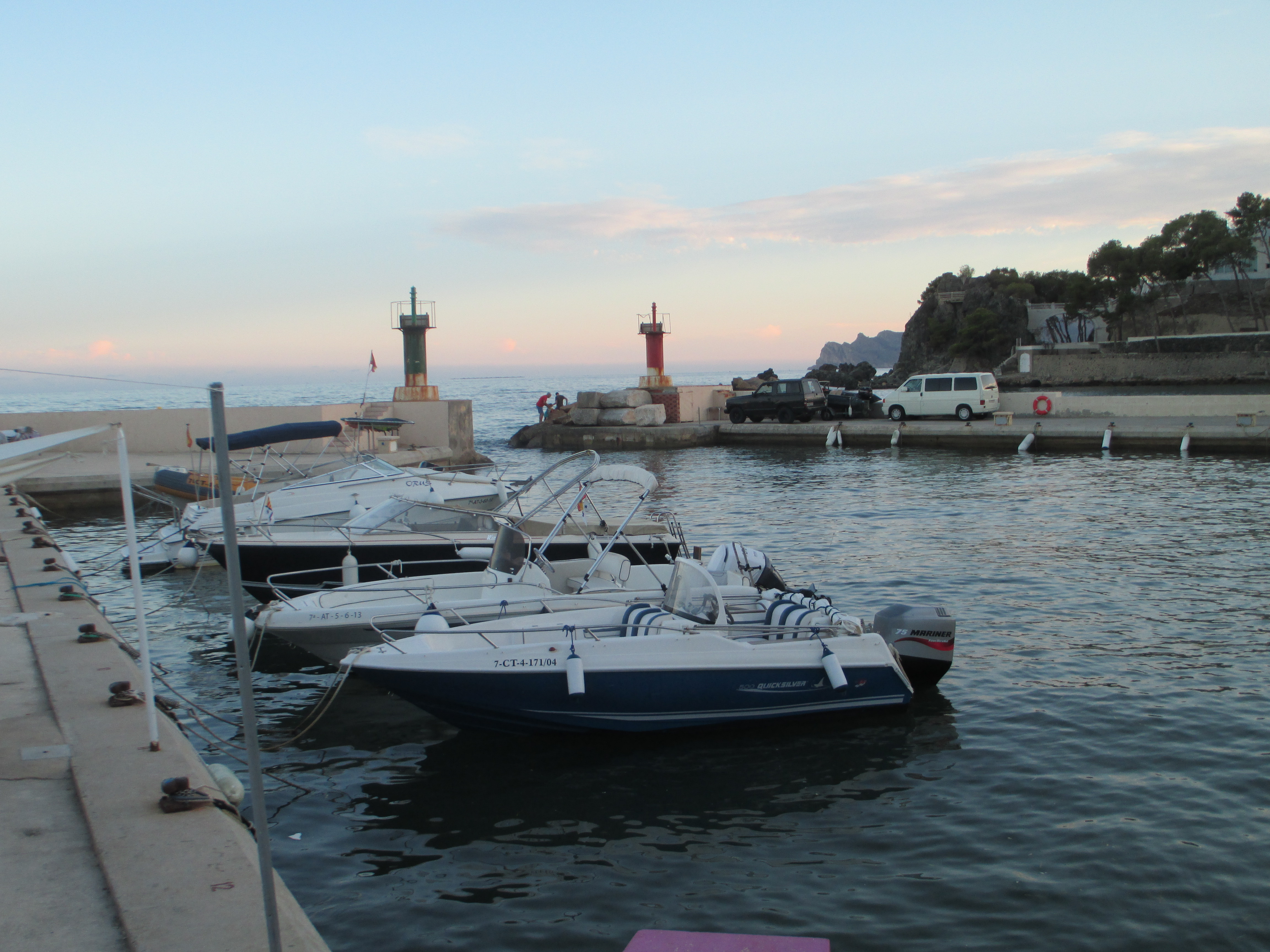
One of the water sports marinas in Altea
There are many water sports available with a number of seaside businesses offering such activities as snorkeling, diving, kayaking, boat rental, sailing lessons, fishing, kitesurfing, and more. I love snorkeling, and every Christmas school vacation, I took my three sons to warm spots with good snorkeling, such Australia, Belize, Hawaii, Mexico, and various Caribbean islands. The Mediterranean in Altea is warmest in July and August, reaching 25C/80F degrees. For me, that is an ideal snorkeling temperature, so I scheduled a boat snorkeling tour this past week. It was postponed due to unusual rain, so I went the following day. The water was not as clear as I was hoping and the sea life not as vibrant to those which I am used to, but it may have partially been due to the recent rain. I enjoyed it anyway. There are also places to snorkel right off the beach without a boat. The dive center from which I took my snorkeling trip was located at Greenwich Marina/ Pueblo Mascarat. It was my first visit there, and I discovered new restaurants, and live music venues, including one, Macao, with outdoor lounge seating, which I plan to soon attend.
In the towns adjacent or near Altea, there are also many activities. This week-end there is the three day Festes de L’Albir, (Fiesta of Albir) with a car parade, children’s activities, food and beverage stand, music, games, and walk to the iconic lighthouse. Several bars in the Albir beach area offer live music, including soul, Latin, rock, comedy to name a few. Bar Cuba is one of my favorite spots, which offers complimentary bachata or other types of Latin dancing at 2000 on Saturday evening, and live Latin music for dancing Saturday and Sunday evening. They also feature other dance lessons throughout the week such as kizomba, salsa, line dance, and mambo for a nominal fee. I enjoy the instructive and professional complimentary bachata

Salsa class at Bar Cuba with Ray
lessons with Andres Ledesma so much, I took some small class private lessons with him.
What are your favorite summertime activities?
Multi-talented Musician and Composer: Danny Pelfrey
25 Jul
Danny Pelfrey playing with Tower of Power
Local musician Danny Pelfrey sat in on saxophone with Tower of Power’s superlative horn section during a performance at Castoro Winery on the Central Coast of California in September 2013. Founded in 1968, Tower of Power is known for their upbeat “urban soul music.” Danny used to be a regular member of the band, and took this fortuitous local performance for a rare reunion. Even though he no longer is in the band, Danny still executed all the synchronized, choreographed horn section moves.
When meeting with Danny for this article, his friendly, humble demeanor belied his musical talents and many accomplishments, awards and accolades. While his achievements and honors are too many to mention, some of the highlights include his having won two Emmys, with a total of nine nominations. He has six BMI Awards and a Video Premiere Award for Best Video for the animated film: Joseph, King of Dreams.
Danny related that he got his start playing guitar at age nine in his home state of West Virginia. He cited Chet Atkins as his first musical hero. Wanting to play with other musicians in the high school band, he took up the trumpet, on which he excelled.
He wrote his first musical arrangement at age 13, and with the encouragement of teachers, he began conducting. While still in high school, he began playing with big bands and jazz groups at a local college.
Danny attended the prestigious Berklee College of Music, the world’s foremost institute for the study of jazz and American music. He honed his performance skills, while also focusing on composing and arranging. He found the vibrant Boston music scene very inspiring.

Danny with Tower of Power
After accepting a teaching job in Canada, Danny started playing with local musicians. Always fascinated with different instruments, he took up tabla, a type of Indian percussion instrument, which he played during performances with a sitar player. He continued to expand the many instruments he played to include flute and alto saxophone. He was particularly drawn to sax as it had the flexibility of woodwinds and the power of brass. This is the instrument for which Danny would become best known.
Danny moved to Los Angeles where he began doing session work and began touring with many prominent artists including Diana Ross, Carole King, Eric Clapton, Melissa Manchester and many others. He especially relished the time playing sax and guitar while touring the world with Carole King, as well as doing recordings and television specials with her. When asked about a particularly memorable experience, he recounted that he performed with Diana Ross during the infamous 1983 deluge of Central Park in New York City. During the increasingly heavy downpour and lightning, the band members had to flee on foot to get back to their hotel.
Danny has recorded with such stellar musicians as Aretha Franklin, Smokey Robinson, David Crosby, Graham Nash, Paul Simon, Eric Clapton, James Taylor, and was a producer for Usher, Brad Paisley, Lee Ann Rimes, Ashanti, Kelly Clarkson, Alicia Keys, and numerous others.
Danny said he was “extremely blessed to have a rich and varied musical career.” He played as a soloist on numerous television shows such as the Wonder Years, Arsenio Hall, David Letterman, The Tonight Show and Rosanne. In addition, he was the score composer for many popular television shows in the United States, wrote commercials for large companies such as Nissan, Toyota, Ford and California Lottery, and has composed a variety of music which can be heard in worldwide. He has also written music for more than 50 interactive games including a Star Trek series. His concert works have been performed by the Knoxville Symphony, the Los Angeles Jewish Symphony, and the National Symphony Orchestra. He has shared concert programs with John Williams, Andrew Lloyd Webber, Igor Stravinsky, and Charles Ives. Danny shared that he particularly enjoyed writing “rich and soulful music.”
Moving to the Central Coast of California in 2009, Danny found the local music scene “very vibrant.” He noted that Cal Poly Performing Arts Center (PAC) brings in excellent quality entertainment. He was primarily spending his time composing, arranging and producing for various media. He was also playing sax with the BarFlyz, which consisted of Kenny Lee Lewis (guitarist for Steve Miller Band), Diane Steinberg Lewis (award-winning pianist and vocalist), Ken Hustad (bass), and Dean Giles (drums.) The Barflyz play pop-cabaret music including jazz, pop, Latin, Broadway and television tunes, and blues. Danny also played with the popular Central Coast band, Human Nature, which features world-inspired music, where he replace original band member, Dave Becker, who relocated to Florida. The band has a diverse repertoire including jazz, samba, funk, Americana, with some original songs written by group leader, Adam Levine, another graduate of the Berklee College of Music.
Danny relatively recently moved to music-centric Nashville where he continues his many musical projects. Current Music recently added Danny’s AMUSICOM to their playlist of quality, downloadable music.
Sant Joan Festival in Altea Spain
26 JunBOOM BOOM BOOM. The sounds outside were so loud as to cause my dog, Pepper, to run to hide under the bed. I peered out of my window which affords a view of the cathedral at the top of Altea’s old town, where I was surprised to see fireworks midday. The fireworks signaled the start of the day’s Sant Joan Festival.

Waiting to be doused with water at Sant Joan festival in Altea
Sant Joan Festivals are very popular in Spain, particularly in the Province of Valencia where I live, as well as in Catalan-speaking areas, and Galicia. Sant Joan is the Valenciana and Catalan languages way of saying Saint John. The Sant Joan festival in Alicante is Spain’s largest, and one of Alicante’s most important festival. The festivals occur around June 23, the day of Sant Joan, typically with numerous days of activities that vary with the location.
In Alicante, there are large “Ninot” characters that are set on fire, much like the famous “falles” festival in Valencia in March. The Ninot are amusing parodies of famous people or politicians made of wood, cardboard, mud, and other items. This year’s Alicante festival occurs for four days. There are noisy early morning (for Spain) wake-ups, parades, costumes, music and many more activities.
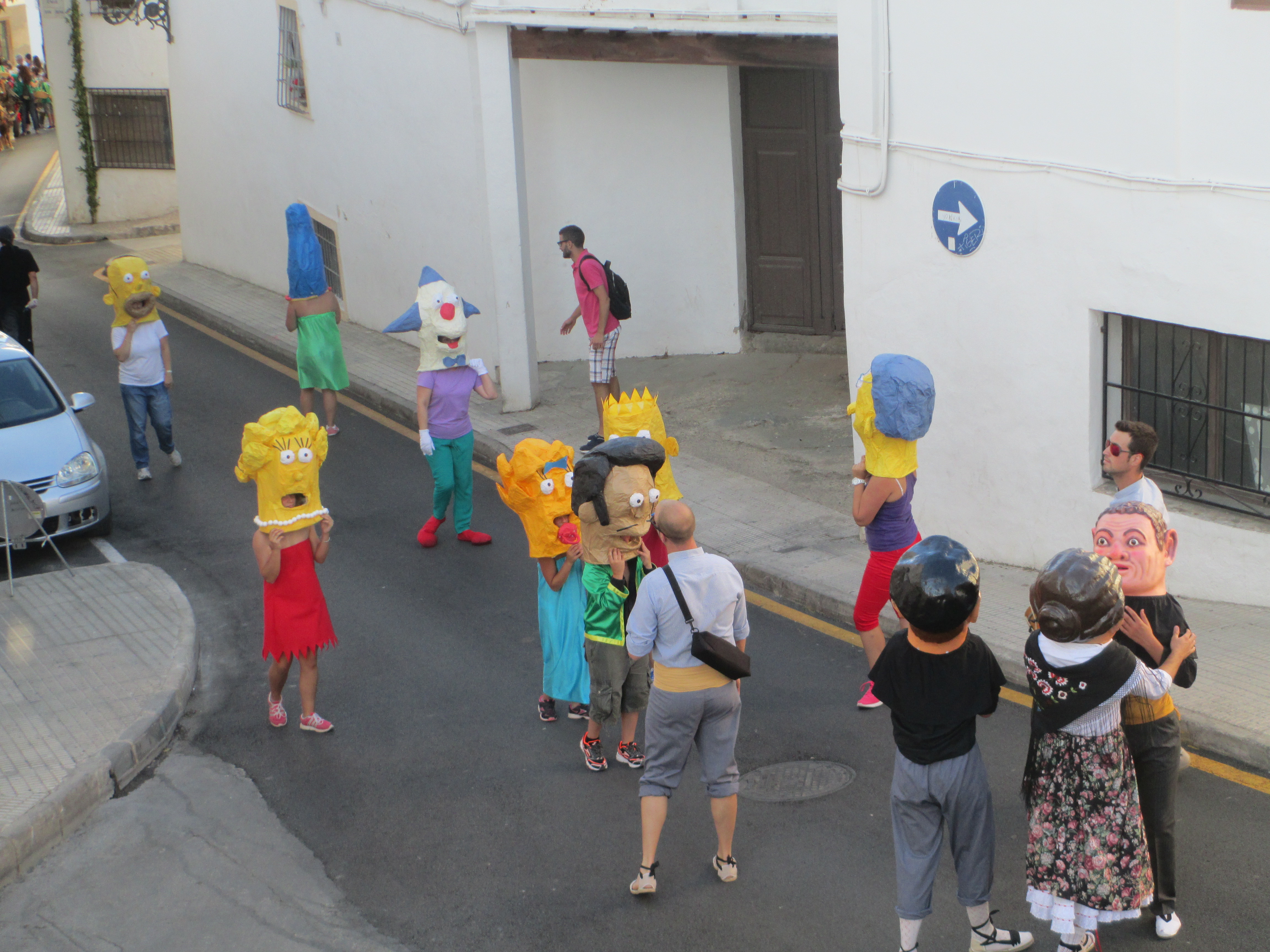
Sant Joan parade with masks
In my town of Altea, when I first heard about the impending festival, I had no idea what to expect. My initiation to the festival was the booming fireworks midday, followed later by a parade of locals with cartoon character heads. There have been three early morning wake-ups by noisy participants yelling, playing instruments, and more fireworks. My apartment is on the street where all the local parade participants go as they head up the hill to the cathedral in Altea’s main plaza. One afternoon, there was a huge pan of traditional paella cooked in the plaza for all to sample. One midnight during the festival, people wade into the ocean. After all, St. John is remembered for baptizing Jesus.
This festival requires stamina. The first group of parade participants, which included many musicians, continued to march and perform for more than 12 hours. During the second afternoon parade, the noisy participants of all ages wore torn t-shirts and were soaking wet as they made their way up the hill. There were two groups, each carrying a tall tree, many drinking from large jugs or other vessels of wine, while the people watching on from their apartments above dump and spray water on the giddy participants.

Raising the tree
Once done with the procession, in the plaza the trees are hoisted to stand erect. Men attempt to climb the tree as high as possible onto the unstable trees to tie on their ripped t-shirt. An ambulance was waiting nearby for anyone who might fall. However, I think it is nearly as dangerous for the women who wear spindly high heel shoes while walking on the uneven, rocky plaza surface, or dancing when the late night band plays.
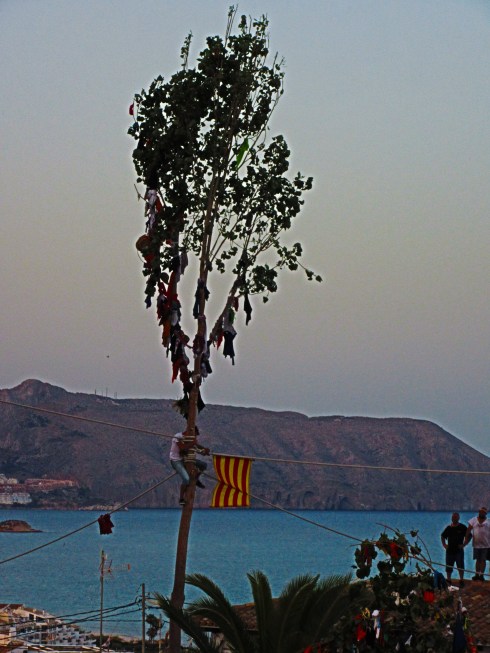
Climbing the tree to tie on a flag
Today, Sunday, parade participants wore traditional costumes while trekking up the hill to the accompanying music followed by a “solemn” mass. There are numerous activities scheduled including more music processions. (Altea music schools for youth and a professional school for adults so music is always a prominent part of any festival.) There will be more fireworks, and in the plaza another giant communal paella, and disco music starting at 11:00 p.m.
What has been your favorite festival experience in Spain?
A Fulfilling, Less Stressful Life Running an Artsy Bar in Idyllic Altea Spain
7 Jun
Sara and David at their artsy bar in Altea
In the same week, Sara Wilson lost her job as a staff writer for a major business magazine, and her husband, David Fernandez, lost his position as a private chef for socialites in New York City. They used that as a springboard to “re-examine our careers and quality of life.” They originally met in France, married and moved to California, then to New York to further their careers. Even though they liked certain aspects of living In New York, their lives were stressful, too money driven, and they didn’t get to spend much time together. Sara reflected, “Life gave us solution when we got laid off within a week of each other.” After considering their options, they initially decided to move to more relaxed Spain with the idea of opening a restaurant with David’s father. When that didn’t work out as anticipated, Sara and David started exploring other options, and eventually settled on opening a bar and eatery.
Sara reported, “My six years at the magazine job interviewing entrepreneurs helped us in the process of starting our business.” She added, “Ironically, I learned from people’s stories and their tips for success.” David had previously completed culinary training in Paris. She noted, “David is more of a visionary and risk-taker than I am, but it was our joint talents that helped us develop a successful business.”

Picturesque and historic Altea
They spent several months exploring towns in the Costa Blanca area along the Mediterranean. They briefly looked at touristy Benidorm, but it did not possess the attractive and friendly location they were seeking. Then, “Unexpectedly we encountered a village paradise…called Altea,” recalled Sara. “We loved Altea’s stunning coastline, white pebble beaches and inviting and tasty restaurants lining the promenade.” But it was when they entered the old town, once a fortress, that they were really “awestruck. We loved its picturesque, narrow, pedestrian streets, punctuated by small artisan shops, that lead up to the hilltop church plaza.” Thus they set about on finding a place in the old town, known as Casco Antiguo.
Not long thereafter, they found an apartment and a place to start their dream business, a café/bar which was promoting various forms of art. “The rent was the cheapest we had found, and was the right size for just the two of us to run.” It consisted of two floors that had been transformed from an old house. We liked the fact that it had a mezzanine, a decent stock room, it was just one street down from the church plaza, and was on one of the most charming streets of Altea.” The business had been operating primarily as a sports bar, with a focus on the arts, as well, hence the name AlteArte. Importantly, “The bar already had a local clientele.”
They bought the business, but not the building. Sara stated, “We had been warned that it was important that the business have an existing business license. Just as we were ready to finalize the purchase, we learned that AlteArte did not have a business license.” The owner had applied for it and it was reportedly in process for a substantial period of time, (not unusual with the Spanish bureaucracy), but it had never been completed. Once the owner was aware that this unresolved issue was holding up the sale, the license was quickly approved. Sara and David speculated that the business license application was likely languishing with the local authorities, and that the owner, who was a local native, got the process completed quickly. Sara said, “It helped to buy a turn-key business, with an established clientele.” The prior owner, who sold them the business, wanted Sara and David to be success, and was supportive in a variety of helpful ways.

Typical evening with friends at AlteArte
Sara and David “wanted to change the ambience to a cozier environment, which we did by adding tables and changing some of the décor.” They later hung their now iconic multi-colored bicycle upside down from the ceiling, and added some other kitschy design elements. They provide Wi-Fi, and show major soccer matches (“fútbol”). “By changing things, we lost some of the former clients but gained others.” During their first year in business, they were often complimented on their tasty mojitos, so they decided to make that a focus. They setup an increasingly growing mojito menu, and identified AlteArte as a “mojiteria,”which set it apart from the other bars. They also make “nojitos,” alcohol-free mojitos. Adapting to client demonstrated preferences, “We abandoned our early idea of making it a coffee-centric business, instead focusing on our excellent selection and preparation of teas,” in addition to other typical bar beverages. Although their service focus is primarily on beverages, they also have a small selection of tapas and quesadillas, the latter being a popular, but rare item in Altea.

Casco Antiguo in Altea
Asked if they have encountered any problems or challenges in setting up their business, they reported initially the neighbors complained about noise and the tables and chairs they had placed on the stairs adjacent to their building. “Eventually, we were able to make peace with the neighbors, after convincing them that we would keep the noise down, and not cause them any problems.” During the slow time of year, they do minor renovations to AlteArte, but they noted it is hard to find qualified people who complete the work in a timely fashion. After deciding to start their business in Altea, Sara quickly began learning Spanish, something she felt essential in running their business.
The owner of their building had been renting out the top floor to various people as a shop with touristic and artisan items, but after a series of several failed businesses there, he asked Sara and David if they were interested in adding the top floor to AlteArte. “We decided to take this opportunity to expand. The top floor is primarily for special events and gallery exhibits, as well as weekly intercambio (Spanish English language exchange.)” AlteArte exhibits “one or two artists’ works each month.” The middle floor is an inviting area with pillows and populated with board games.
“The customers, new and old, shaped AlteArte’s atmosphere by natural evolution.” They have about an equal percentage of local and expat customers, with “most ex-pats in this area of the Costa Blanca area of Spain being Scandinavian.” In the beginning, most of their clientele came through word of mouth and Facebook. After opening the gallery on the third level, we reached out to local newspapers and magazines to promote those events.”
After they first opened in February 2010, Sara and David ran the business by themselves. “During our second and third summer, we hired our first employees. In our fourth year of operation, we hired Emily as our first full time employee. She had been a patron, and she had a good work track record of seven years at one local restaurant.” They emphasized it is very important to check out the reliability and work history of potential employees in Spain as there are generous laws favoring them, such as being allowed substantial sick leave just after being hired. A few months later, they hired another young woman, Ampy, full-time. Both employees are friendly, competent, and able to communicate with the clients regardless of what language they speak. “We pay them a little more than the typical local wage, and uncommonly, we also give them one day off a week including during the busy summer months.”

Sara and David inside AlteArte
When asked about other start-up or ongoing expenses or requirements, “there was an initial food safety course, basic business insurance, and nominal annual taxes.” They have not had any tax liability in the United States based on their Spanish net income. “We recommend using a gestoria,” which is a person whose task is to deal with the idiosyncrasies of Spanish government departments, for paying complex fees and taxes. “We receive an annual visit from the health department to check for correct refrigerator temperature and proper sanitation.” With regard to promoting AlteArte, “We have done some marketing by advertising our business in local tourist maps. Because we are in the Old Town, which is a steep, historically-protected area, we are not required to have handicap accessible facilities.” Sara reported, “AlteArte has allowed us to cover all of our expenses including the luxury of having two employees” which affords Sara the opportunity to spend long visits with her family in California. This year she has had two separate one-month visits with her family. AlteArte has given David, now 40, and Sara, 37, “a more comfortable, and significantly less stressful lifestyle than at our prior high pressure jobs, and the opportunity to spend more quality time together.”
When asked what advice they would give to others considering opening a business in Spain, they recommend, “Be patient and committed.” They said, “One cannot expect to open a business just for a summer, and turn a profit.” They also stated it is important to understand the demand for the type of business one is considering, and the required permits if starting from scratch. “It is also essential to have enough capital for start-up costs, slow periods, and unexpected expenses.” Sara said, “I’m kind of glad I didn’t know before we started how many businesses end up closing down.”
Now celebrating over six years of operation, AlteArte, is a favorite with local ex-pats, Spaniards, and international travelers. They feature monthly art exhibits by local artists; a book club for which Sara often arranges for the author to be present in person or remotely; live music; weekly Spanish-English language exchange (intercambio); movie nights, craft, drama and dance workshops, cooking competitions, and many more. Asked about her most cherished memory, Sara quickly reported it was when director Eugenio Mira, an Altean native, chose to premier his movie Grand Piano at AlteArte, and afterwards had a question and answer session.
WORLD’S TEN BEST BAR EXPERIENCES
7 May
Harry’s Bar
Courtesy: Share Alike
HARRY’S BAR (VENICE, ITALY): During my last trip to Venice, I became a “regular” at Harry’s Bar, albeit sadly only temporarily. By the second visit, the waiter inquired if I would again like a bellini, (Prosecco with rosy-hued peach puree.) Thereafter, when I entered, he would give a nod and subtle smile. Whenever I am in Venice, I relish spending time at this iconic bar where I find the ambience enchanting and service impeccable. I think the patrons who complain about the prices, dress code, and service just don’t get it. This is an elegant, historical place which has maintained the tradition that has made it so loved. If one looks close, it will become apparent that Harry’s has a surprisingly simple approach to drinks, cuisine and atmosphere. Bellinis are served in the simple clear highball-type glass etched with the Harry’s Bar logo. They favor local, relatively inexpensive wines over high-priced wines. The food is simply but perfectly prepared, such as the popular French toasted cheese sandwich. The upstairs dining room also serves fresh, simple, sumptuous food. I like to slide into the bar in the afternoon to relax and refresh myself in between exploring areas where tourists are seldom seen. My smile, polite salutations and attempts at speaking Italian have always been greeted with nothing but cordial attention and professional service. For me, Harry’s is worth every penny I’ve spent there.

Calle Ocho
CALLE OCHO (BORDEAUX, FRANCE): Cuban music was blaring out onto the pedestrian-only street in Bordeaux. Ever a lover of music venues, and a huge fan of Cuban music, I ventured in. This was an atmospheric, dive bar with mojitos being mixed and served non-stop. Cuban cigars were plentiful in the din of the music and many languages being spoken. I made the mistake of saying a few friendly sentences to the enebriated woman beside me. That did it-she unleashed a torrent of words along with large plumes of smoke, telling me of moving from Cuba to Bordeaux and then a series of unfortunate events that had befallen her with regard to love, work and where she lived. Shaking my head in a sympathetic manner apparently encouraged her, but in reality I only understood a portion of what she said. This loud, lively convivial Cuban bar was a surprising find in Bordeaux, although my new “friend” discreetly informed me of the abundance of ex-pat Cubans living there.
RIO SCENARIUM (RIO DE JANEIRO, BRAZIL): The exhilarating, pulsating rhythm of Brazilian samba greeted us as we exited our cab to the colorful three story beacon that is the Rio Scenarium located on an otherwise dark street. We were seated on the first floor where we primed ourselves with caipirinhas – Brazil’s national drink – and danced to the infectious music. Samba was excellently executed, but all styles of dance were welcome. The crowd consisted of all ages; the younger crowd gravitated to the upper two floors for music more suited to their taste. We had friendly table neighbors, and talked when we could make ourselves heard. Rio Scenarium’s evocative atmosphere is an eclectic explosion of antiques, memorabilia, and kitsch.

Palapa Bar and Grill
PALAPA BAR & GRILL (AMBERGRIS CAYE, SAN PEDRO, BELIZE): Sitting under the square palapa (palm grass) roof overlooking the crystal clear, vibrant blue of the Caribbean below is one of my favorite bar views. A half mile north of San Pedro town, is Palapa Bar & Grill. We stumbled on it, or more accurately, discovered it when our family was exploring the north end of Ambergris Caye while driving a golf cart (the standard mode of transportation on the island.) The main bar is on the second floor which affords a panoramic vista of the water out to the barrier reef, the second longest in the world. We love the fresh fruit cocktails and “mocktails” for the kids. The other “bar” is in the water below where you can float on inflated tire inner tubes while buckets of icy cold local Belikin beer are dispatched to you by rope. Don’t forget to “leave your mark” by writing something on the bar.

Swing Dancing to Stompy Jones at Top of the Mark
TOP OF THE MARK (INTERCONTINENTAL HOTEL: SAN FRANCISCO): Swing dancing on the 19th floor rooftop bar with a spectacular 360 degree panoramic view of the San Francisco skyline is a rarified experience. Located on Nob Hill in the Intercontinental Hotel, the historic bar opened in 1939. What made this locale particularly fun was the live entertainment. On several occasions, I had the chance to listen and dance to the Stompy Jones band, who play revved up “jump style” swing music. The sextet was formed in 1998, and has since received numerous accolades and awards, even being featured in two movies. Donning characteristic short 1930’s-style ties, the band features bounce, piano, thumpin’ stand-up bass, double-shuffle drumming, trumpet sax, and vocals. I also enjoyed the talented pianist and vocalist, Ricardo Scales, who plays many musical styles; my favorite is Latin Jazz. Sample the ambitious “100 martinis” offered at Top of the Mark. The last time I was there the service was extremely poor, even though the bar was not that crowded.
MOCAMBO BAR (TAORMINA, SICILY, ITALY): After an Italian woman spontaneously stood up and danced an exactingly authentic tarantella to the live transient band at a panoramic restaurant in Taormina, we were eager for more music and dance. We headed down the street and in the main square found Mocambo Bar. Unaware of its storied past, opening in 1952 and hosting a number of celebrities, we settled in on the outdoor patio adorned with oleander and orange blossoms which had views of Mt. Etna and the sea. Not usually one for audience participation, when summoned, we reluctantly joined other enlisted audience members to play various percussion instruments with the keyboardist in the indoor part of the bar. Our shared experience and musical ineptitude cemented an immediate bond between we newly recruited musicians; we sat together sharing travel stories, laughing, drinking and dancing. It was a magical night.

Hearst Castle’s Neptune Pool
HEARST CASTLE NEPTUNE POOL PATIO (SAN SIMEON, CALIFORNIA): We sipped our sparkling wine by the Neptune Pool, against the backdrop of the Pacific Ocean on one side and the imposing Casa Grande (more commonly called Hearst Castle) on the other. Construction of the Neptune Pool with its Roman temple façade began in 1924, and after several design changes was finally completed in 1936 with marble pavilions, serpentine tiles, fountains, and alabaster lanterns. We dressed in period clothing, as did many other attendees at “Enchanted Evening,” the Castle’s annual gala. We walked around the pool while sampling appetizers and listening to the chamber string orchestra in this mesmerizing location. As the fog rolled in, the lighting proffered an ethereal atmosphere. We reluctantly tore ourselves away and headed for the dinner and auction with hopes of winning the opportunity to swim in the Neptune Pool.
HEMINGWAY BAR (RITZ, PARIS, FRANCE): Tucked in the back of the Ritz is the legendary Hemingway Bar. Renowned bars are often over-rated – the Hemingway is a noteworthy exception. The atmosphere is cozy and clubby with wood walls and comfortable leather chairs, tasty snacks and fantastic cocktails. Papa’s gun, bust, and mementos adorn the walls. Mixologist extraordinaire Colin Field made this the place to get the city’s best cocktails. The Ritz and the Hemingway Bar closed for major renovations not long after we stayed there in 2012, but plans are for the Bar to re-open after the improvements. I just hope they will retain the original atmosphere and convince Colin Field to return.
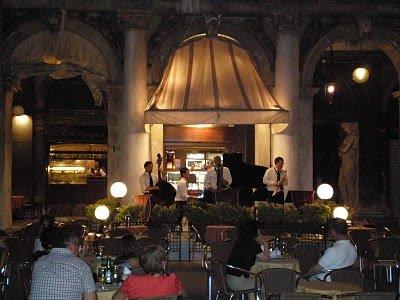
Gran Caffe Chioggia
Courtesy: Creative Common
GRAN CAFFE CHIOGGIA (VENICE, ITALY): Located on Piazzetta di San Marco with views of St. Mark’s Basilica, the Doge’s palace, the clock tower and the lagoon, Gran Caffe Chioggia is always my final stop for the evening. The band is phenomenal, the best on the Piazza or Piazetta, and I daresay some of the most talented, entertaining musicians. Led by the exceptional violinist, Joseph Martin Miotti, the band plays a dazzling array of musical styles including classical, gypsy, swing, rock, tango, movie themes and more with the other band members playing piano, stand-up bass, accordion. The charismatic Joseph manages to communicate humor in some songs such as his quirky rendition of the theme from the Pink Panther movie (which can be seen on YouTube.). We found the tuxedo-clad waiters professional and polite; service can be slow and it is expensive, but there is not a cover charge to listen to the music as there are in other venues on the Piazza. Many people choose to stand outside of the seating area to enjoy the music, but I prefer a more experiential encounter by sitting in the thick of the action. In inclement weather, the band plays under the historic portico. During my first visit many years ago, on a rainy evening we enjoyed swing dancing to the band’s big band sounds under the warm, amber-hued lighting under the portico.

Norman Vito at Petrossian Bar
PETROSSIAN BAR AND LOUNGE AT BACCARAT BAR (BELLAGIO, LAS VEGAS, NEVADA): Located in plain sight, but under-appreciated, are two gems for live music. The elegant Petrossian Bar, located just across from the Bellagio’s front desk and around the corner from the gorgeous flower conservatory and botanical gardens, prominently displays a one-of-kind Steinway grand. The pianists are extremely talented; I spoke with several of them who all had interesting histories to share. For example, Norman Vito told me of growing up in the Philippines and his experiences with Imelda Marcos and Van Cliburn. The music starts at 10 a.m. and continues with a
series of pianists until closing at 12:45 a.m. The Petrosssian Bar has varied offerings including traditional afternoon tea service, Russian specialties such as caviar, smoked salmon, and vodka samples, and a nice selection of wine and specialty-infused cocktails. Only a few short steps away is the Lounge at the Baccarat Bar, which features classic jazz in a stylish, sleek environment. The rotating musicians typically include a pianist/vocalist and a stand-up bass. The Lounge affords of a view of the high-end Baccarat gaming. I was quite amused by the cast of characters playing Baccarat – those dressed to the nines, slouchy-dressed, nervous chain smokers, young hipsters, superstitious seat movers, and more. The bar offers a good selection of wine and cocktails. Performances start at 4:15 p.m. and continue until 1:00 a.m.

Harry’s Bellini:
Hope to see you soon: Cheers!
Three Days in Enchanting Granada
24 Apr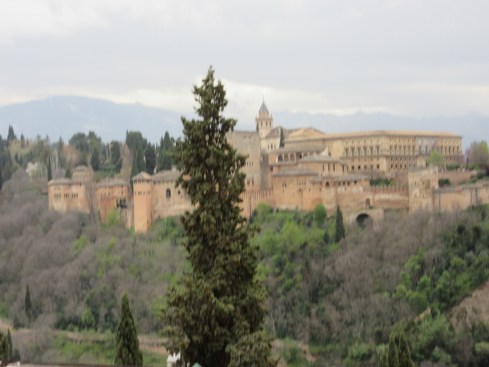
The Alhambra
As previously arranged, the last Muslim ruler in Spain, Boadbil, reluctantly handed over the key to the spectacular Alhambra to the Spanish monarchy on January 1, 1492. No matter how much I have read about the Alhambra, I was still gobsmacked by it, from its size and beauty, intricate carvings, water features, gardens and the overall grand, but tranquil, enchanting ambience. By 1238, with the taking of Cordoba from the Moors, the Spanish “Reconquista” had regained all of Spain with the exception of Granada. Under a peace agreement with the Spanish monarchy, Granada flourished. Under Moorish rule, the site of the Alhambra was used as a fortress, and in the 13th century the Nasrid Dynasty began building the Alhambra complex. Any attempt to provide an accurate portrayal of the Alhambra will be woefully inadequate in describing its unique architecture and beauty. The Generalife, the nearby country gardens and buildings on the Alhambra’s northern area are perched higher, resulting in a cooler, inviting respite for the Nasrid rulers and their associates. A view of the snow-capped Sierra Nevada, Spain’s tallest mountain range, can be enjoyed from the Generalilfe. I recommend the tour of both the Alhambra and Generalife, which takes around 4 ½ hours. Be sure to purchase your tickets well in advance as tickets are often sold out, arrive early, and wear comfortable walking shoes and bring shade from the sun.

Palace of Charles V
After more than 250 years of rule under the Moors, King Fernando and Queen Isabel fought to restore Granada to Spain, which they succeeded in doing on January 1, 1492. The Alhambra was spared from the usual destruction and/or conversion to Christian buildings, which makes it a unique attraction. However, their grandson, Charles V, built a palace in the Renaissance style within the walls of the Alhambra, which makes for an odd, but interesting juxtaposition to the Moorish designs. This building houses museums of Spanish-Islamic Art and Bella Artes (Fine Arts.)

The Albaicín is the Moorish old city, which faces and provides one of the many fantastic views of the Alhambra. The Albaicín has a jumble of narrow streets and historic homes called Carmenes, the latter which consist of external high walls to provide privacy and internal fountains, patios and inviting living spaces. The Albaicín church of San Nicolas is a popular destination, and its plaza affords panoramic views. In the hills just above the Albaicín is the El Sacromonte, the caves where gypsies live and perform flamenco shows.
In 1523, work began on Granada’s Cathedral, which is massive and opulent, featuring both Gothic and Renaissance architecture created by a series of several architects during the 181 years during which it was constructed. It is one of the largest Cathedrals in Europe. It has a gold and white interior and features a circular capilla mayor (sanctuary) with five naves and multiple chapels. Its stained glass dome, large chorale books, and huge pipe organs are also noteworthy. Adjacent and joined to the Cathedral is the Capilla Real, the Royal Chapel, which was built for the royal monarchs between 1506 and 1521. It houses an ornate grille enclosing the altar and the marble sculptures of Fernando and Isabel, their daughter, Juana La Loca and her husband Felipe el Hermoso. Their coffins lay in the crypt below the marble figures. Both facilities offer works of famous artists.

Plaza Nueva is the oldest square in Granada, and a good place for a beverage, tapa and people-watching. One of my favorite spots is Bodega Catañeda, a rustic, authentic tapas spot for local jamones (hams), creative dishes, and sherry. There are many eateries serving authentic Moroccan and Arabic food. Granada is fairly compact, so walking or taking a cab are the best options for getting around.

Bodegas Castaneda
Since moving to Spain, I have happily taken advantage of the opportunity to explore the country’s diverse and unique attractions, including many UNESCO world heritage sites. For this special venue in Granada, I splurged and stayed at the 14th century Parador within the walls of the Alhambra. In Spain, a parador is a historic or scenic building which the Spanish government has converted into an inn or hotel. The parador at the Alhambra has been described as the best or one of the best in Spain. Queen Isabel and King Fernando were initially buried on the site, while the Royal Chapel was being built in Granada as their final resting place. The parador was a former monastery built on orders of the royal monarchs on a site which was originally a mosque. This parador provides an inviting, tranquil respite after exploring the Alhambra and the City of Granada, and its intriguing history and delicious local foods.
Alluring Alicante: Top Stops
4 Apr
Alicante with Santa Barbara Castle on the hill
Living in the beautiful, low-cost Mediterranean area of Spain known as the Costa Blanca offers many advantages, not the least of which is the opportunity to travel to enticing, affordable historical and cultural places in the country. Since moving to the Costa Blanca, I have been enjoying nearby venues, all within about an hour’s drive. Almost everything in Alicante is centrally located, so no vehicle is needed once you arrive, although local trams are available if one wants to explore outlying areas.
The cosmopolitan area, now known as Alicante, has been inhabited over 7000 years, with periods of rule by the Greeks, Phoenicians, Carthaginians, Romans, Visigoths, and Moors. One of the iconic sites visible from much of the city of Alicante is the hilltop Santa Bárbara Castle, which dates back to the period of Muslim rule starting in the 8th century. It was named for the saint day on which Castilian forces captured it on December 4, 1248. Over the centuries it endured many captures and bombardments, and was sometimes used as a prison. After a period of disuse, it was opened to the public. Entry is free, but there is a small fee to use the elevators to get to the top, or one can walk to the top. The panoramic view is spectacular.

Alicante Barrio
Located near the Santa Bárbara Castle, is El Barrio, “the Old Quarter,” which features narrow pedestrian streets, with colorful homes and flowers, a photographer’s delight. There are numerous interesting historic buildings including St. Mary’s Church, built between the 14th to 16th centuries on top of a former mosque. Its ornate baroque façade and interior are a worthwhile stop. The Ayuntamiento (Town Hall) is a baroque building located behind the Explanada Park. Besides the beautiful architecture of the exterior, inside there are historic archeological remains, the famous “blue room,” a chapel, and cota cero, a reference point inside the building from where the height of sea levels throughout Spain can be measured.
El Barrio also has shops and stores featuring everything from handmade crafts to luxury brands. Leather manufacturing is a major industry in the Alicante area, so inexpensive quality leather products are widely available.

Iconic Explanada
Alicante is well-known for its regional cuisine. There are many dining options, from informal to formal including traditional tapas to innovative gourmet tapas, paellas, fish and seafood, as well as other types of regional Spanish and international cuisines. For foodies, a visit to the Mercado Central will delight the senses with abundant displays of fresh and unique offerings. There are places to purchase prepared food in the market, and cafes just outside. Another area offering quality cuisine is in the marina area, which can be reached by taking a stroll down the Explanada de España, which is the palm-lined walkway along the Mediterranean. It is paved with six and a half million marble floor mosaic tiles laid in such a way as to create a wave-like appearance; many consider this one of the most beautiful beachside walkways in Spain.
Spaniards love friends, family, fun, and festivals. To that end, in both the Old Town and in the Marina areas, there are many inviting sidewalk cafes for socialization and rejuvenation during the day, and lively bars or discotheques where people party until the early morning hours.
Prices for a nice hotel typically start around 70€; an apartment or vacation rental may be even less expensive with two or more bedrooms, kitchenette, common living areas and laundry facilities; most beverages including wine, beer, water, and soda for around 2€; and menu del dias (two or three course special menu of the day for as low as 10€.)
Connect with Me


 Starr Treks