Here is my article about Spain which was just published in Insiders Abroad:
Archive | Altea RSS feed for this section












Is There Customer Service in Spain?
11 NovI love most things about living in Spain, but customer service is not one of them. I have even contended they should remove the Spanish words for customer service, “atención al cliente,” from the lexicon. I have previously recounted my problems in receiving packages with my personal belongings from California. When I first reported no monetary value for the old personal items mailed to me, the Spanish authorities returned the package to the U.S. I tried unsuccessfully twice more to have my belongings sent. The last time, I completed all the requirements within the mandated time period, paid nearly 100 Euros in customs fees, and they still returned my package to California. By this time, all the potentially breakable items had broken. I never received the refund I requested. One package I did eventually receive was gaping open and the contents from the top of the box were missing; the Spanish postal service was not even professional enough to tape it closed. Then the postal worker who “delivered” the box claimed it was heavy and asked me to help carry it into my apartment.
If I mail order something from the U.S., there are huge import taxes, but there are some things worth paying extra for that I cannot get here in Spain. I have also mail ordered items from Spanish companies, and more often than not, the couriers claim they tried to deliver my package, even when I had been home the whole day. When I call the number they provide for the supposed missed delivery, they argue with me, saying they did come to my place and ring my doorbell. They are never wrong, and never apologize. One agent insisted they had a photo of the courier at my door, but when I asked them to send it, I was told they could not.
My friends and I have had similar difficulties when using a taxi. Some drivers will ignore directions I provide to avoid traffic snarls. They may bark at you for having an inadequate command of Spanish. The other day, our cab driver from our town of Altea was unfamiliar with any of the streets or major landmarks in our village.
Most of the time the food here is great, but there are occasions when the restaurant serves sub-par food. If they ask how the food was, and you give an honest assessment, most of the time, I have received the blank “Bambi in headlights” look, with no offer of any reparations. Once, when I tried to return or exchange a podiatry device which broke after one use, the pharmacist looked at me, shrugged her shoulders and said there is no guarantee on products they sell. WHAT?!
I recently learned of an even more ridiculous incident. A woman bought a pair of shoes, and when she got home and looked at them, she discovered they had given her two different sizes. When she went to correct the error, with receipt in hand, they insisted they had made no mistake, even suggesting she may have gone to another store to buy another pair to make a mismatched set. Her husband had no better success in attempting to rectify what should have been a simple exchange, accompanied by an apology.
And I won’t even start on confounding, changing requirements of the government bureaucracies in getting required documentation for a visa, registering your living address, getting a bank account and more. There is even a hilarious videos representative of many people’s exasperating experiences, which I have previously viewed on YouTube, although it seemed to have been removed when I tried to find it.
My recommendation in Spain is to remember, The client is always wrong.
A Humorous Guide to Smoking in Spain
2 Nov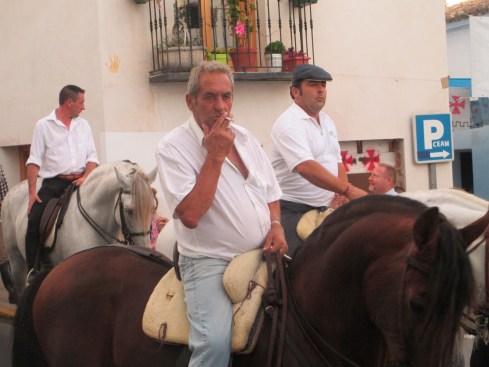 Although smoking is not allowed indoors, it doesn’t count if you light up while heading for the door.
- Nor does is count if you stand in the doorway and smoke.
- You can stand at the outside window counter of a bar/restaurant designed for serving people outside, and while facing the inside, blow smoke inside.
- You can smoke in an outdoor restaurant patio, even if enclosed or babies/children are present.
- You can hold your baby or child while smoking.
- You can throw your lit cigarette into the street when finished, regardless of whether you are walking, driving, or are on your third or fourth floor home balcony.
- You can publicly smoke at your job.
- You would rather sit outdoors so you can smoke, even in inclement weather.
- Don’t worry if your smoking bothers anyone else.
- You can smoke outside the gym door before and after exercising, and if you need a smoke break during your workout.
- Buy household items that can be used both as vessels for serving food and as an ashtray.
![IMG_0398[1]](https://starrtreks.com/wp-content/uploads/2015/03/img_03981.jpg?w=300&h=225)
Cups that can be used to serve food such as allioli (Spanish version of aioli) or can be an ashtray. I’m not kidding. See the four protrusions on top designed for putting cigarettes when vessel is empty.
![IMG_0398[1]](https://starrtreks.com/wp-content/uploads/2015/03/img_03981.jpg)
Taxi Travel Perils and Moros y Cristianos in Altea Spain
9 Oct
Moros
“The taxi driver wouldn’t follow the directions you provided. He said, ‘Moros y Cristianos’ and ‘impossible,’ then stopped, unloaded our luggage and told us to get out. We don’t know where we are.” This was the first comment from my friend who had just arrived in Altea from California. In addition, the WhatsApp wouldn’t work for her, so I hadn’t gotten any of her prior calls. Having not heard from them at the expected arrival time, I then called her via regular (expensive) international mobile rates, which is when I received her panicked statement.

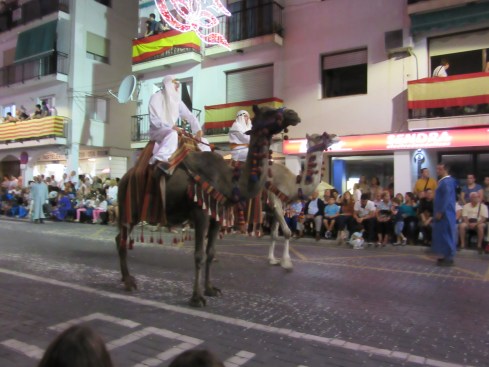
Camels with Moros
In anticipation of the arrival of my two girl friends from California, I fretted over possible, or should I say probable, problems with the cab driver getting to my apartment during the annual Moros y Cristianos (Moors and Christian) festival. This was not my first problematic experience with Spanish cab drivers. My fear was realized, in spite of spending several days providing a map and writing out the directions in Spanish (and English so my friends could see if he was going the right way.) At the beginning of the directions was the admonition in Spanish (which my friend read aloud) not to go the usual way due to the Moros y Cristianos festival. In response, he simply entered my address into his guidance system, and drove to the starting spot of the parade, at which point he dropped them off on the highway (Carretera 332) that runs through Altea.

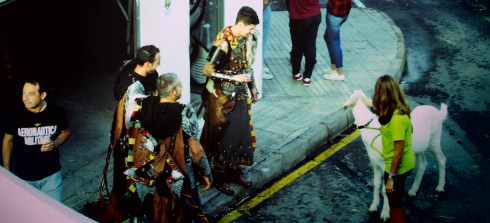
Christian fila party across from my apartment
After eventually figuring out where they were, I found them near the start of the Moros y Cristianos parade route. With luggage in tow, we then proceeded to the seats on the parade route a local friend had saved for us. Although I had told them they would be in Altea during the Moros y Cristianos festival, they had no idea of the magnitude and pageantry of it. The festival commemorates the Christians reconquering the areas of Spain that had been conquered earlier by the Moors.

King in the procession to the church plaza from my window
Nor did they anticipate the incredible level of noise associated with most festivals in Spain. In the early morning, there is the despierta (wake-up) when the local filas (brotherhoods) proceed up the hill toward the church plaza while their respective brass bands play and others fire noise-making guns and firecrackers, all the while drinking and smoking. (Having attended the festival for two years, I have only seen one Muslim participate.) Throughout the day, the many filas have parties at their individual sites, with food, alcohol and music. The fila Moros across the street from my balcony, Els Malvins, have a fabulous group of musicians, which I am privileged to enjoy without having to leave my home. In addition, there are many other adjunctive activities such as midnight fireworks, re-enactment of battles between the two groups,

Solemn religious procession
The festival culminates with evening parades, first the Moros, the next day a solemn religious procession, and finally the Christians. After those parades, the filas return to their home sites where they continue to party until the early hours of the morning. In addition, there are live music/dance venues that start after midnight and go for many hours. I don’t know how they can stay awake that long, let alone, party that intensely. Tellingly, on the day after the festival ends, almost all of the local businesses are closed, apparently for recuperation and clean up.
Quail with apple slices, grapes fruit compote
My friends were thrilled with the Moros y Cristianos festival, as well as many other aspects of Spain, including the friendly international locals, the many varieties of activities, day trips to other towns, fabulous food and the ambience of beautiful Altea.
Adventure to El Campello
3 SepEnjoying Xiringuito Ton-Tin with Sandie Sheppard
With so many interesting places and events here on the Costa Blanca in Spain, I have decided to start taking short trips to some of these spots. Serendipitously, I met a woman at a local jazz fusion concert, who also is a live music fan. While we shared a table, I was expressing my frustration about the difficulty finding information on the internet about live music venues. She then volunteered that she knew several live music venues and offered to send me the information.
Xiringuito Ton-Tin in El Campello, just north of Alicante, was one of the locations she recommended. During July and August, they offered daily performances every evening. The day we went the saxophone and trumpet players were featuring jazz, soul, bossa nova, and swing. The two musicians were fantastic. A few people danced, but at other events there seem to be far more dancers. Xiringuito Ton-Tin features a wide variety of music genres, and will continue to have live performances in September. It is located on the beach, with the seats and tables and large globe-shaped white lamps, all situated on the sand, which we loved. For those unfamiliar, Xiringuito, also spelled chiringuito, is typically a small beachside business where one can get beverages and snacks. Many times they are only seasonal summer spots. Xiringuito Ton-Tin regularly posts their calendar of events and video excerpts of concerts. Reservations are recommended as many tables were booked in advance.
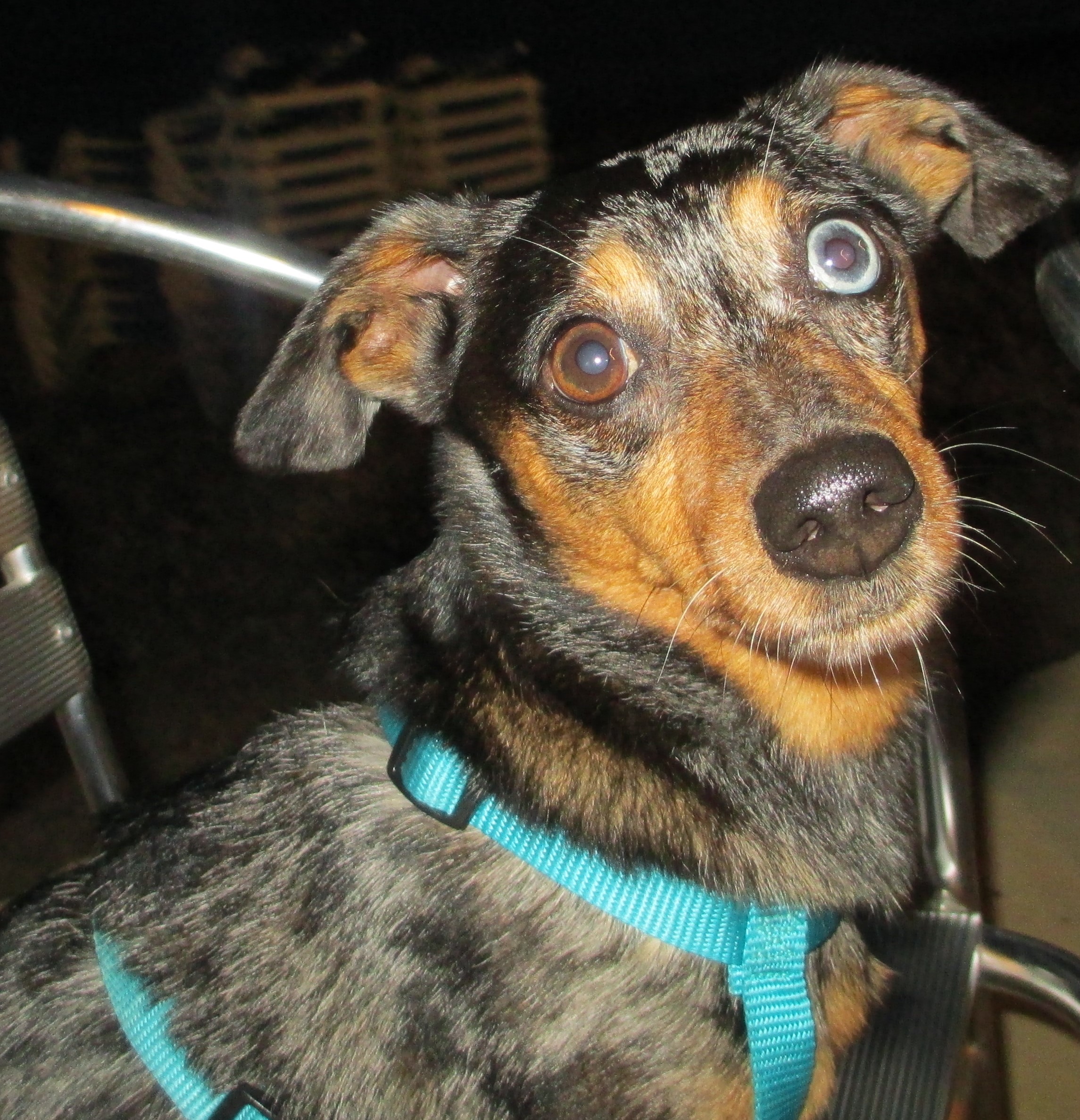
Pepper at a concert
To get there, we took the tram from Altea to El Campello, which took a little over an hour. I brought my little dog in a wheelie back-back, although I have gotten inconsistent information on whether pets are allowed, so I just placed the backpack in a position between my legs where no one could see what was inside. When we arrived, we ate at a local restaurant across the street from the ocean, and a very short distance from the tram station from which we exited. I only booked the trip the day before we left, yet still managed to find a reasonably-priced hotel that was pet-friendly in nearby San Joan d’Alacant. It was a bit too far for us to walk, so we took cabs to the hotel. A couple of times, the drivers appeared to be taking a circuitous route, which unnecessarily added to the fare, but I wasn’t familiar enough with the area to give directions.
The next morning, we took a cab to another area of El Campello, including a busy, active beach area. It offered numerous cafes and restaurants, a variety of water sports including an inflatable floating gym for kids. In the heart of central El Campello, there were some quality eateries for very reasonable prices, and interesting stores if you enjoy shopping (which I don’t.) We headed back to Altea mid-afternoon. This was a very economical trip, even with all of the activities, food and beverages. I am looking forward to my next Costa Blanca adventure.
Have you had any memorable short trips?
Summer Fun in Altea Spain
21 Aug
Summer in Altea’s Casco Antiguo with craft booths
While Altea (Spain) always has many entertaining activities, summer brings additional fun offerings. Ever a music fan, I appreciate the variety of city-sponsored live bands playing at various outdoor venues, including 40’s style Big Band, jazz fusion with a Mohawk-sporting accordion and keyboard player, flamenco, regional (Valenciano) folk music, to mention a few. I also went to a rock jam session held on Sunday afternoon at a local tram station, which had an eclectic, inviting atmosphere.

One of the 60 mural paintings hanging from balconies in Altea’s Casco Antigua
In Altea’s hilltop Casco Antiquo, (Old Town), the church plaza and the walkway to it, which are sparsely filled during the winter months (as exemplified my Facebook cover photo), are now packed with throngs of visitors and locals. This month in Casco Antiguo there are a display of 60 painted murals by different artists which hang off balconies, hence named Balconades d’Altea. Also during the summer in Casco Antiguo, there are many artisan craft booths featuring various types of original art, jewelry, leather and more. Most restaurants in Casco Antiguo are open for the summer season, with many types of cuisine available such as Spanish, French, Italian, and other ethnic cuisines.

L’Olla fireworks
In June, we had the San Joan (Valenciano) for St. John festival, which features water-inspired activities, including parades and midnight bonfires at the beach, which normally are prohibited. Another popular summer beach activity is the spectacular firework display, Castell de l’Olla, over the Mediterranean. People head down to the beach with beverages and/or picnics for the midnight show, which this year lasted over 30 minutes. Alternatively, people may watch the show from the comfort of their balconies or terraces, as I did, or a café in Casco Antiguo’s plaza.
During the summer, many people enjoy going to temporary, seasonal chiringuitos, beachside bars/restaurants, which offer full service food and beverages with tables, and shade, if desired. I recently went to bonavida, a great chiringuito on the beach where I love their fried fish and seafood plate. (I recently posted a short video from it on my Facebook.) On many of the beach areas, there are lounge beach chairs and umbrellas available for rent.
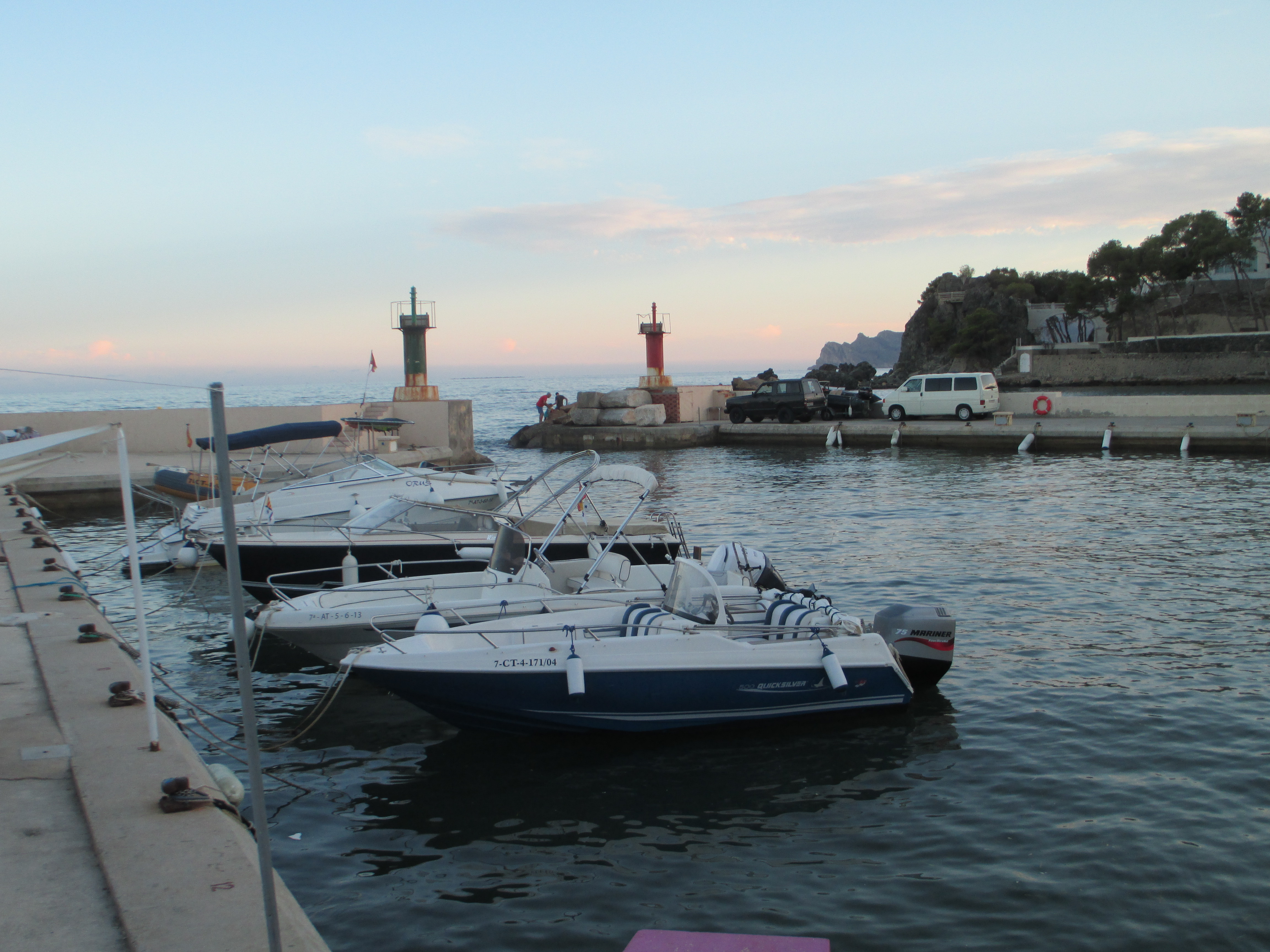
One of the water sports marinas in Altea
There are many water sports available with a number of seaside businesses offering such activities as snorkeling, diving, kayaking, boat rental, sailing lessons, fishing, kitesurfing, and more. I love snorkeling, and every Christmas school vacation, I took my three sons to warm spots with good snorkeling, such Australia, Belize, Hawaii, Mexico, and various Caribbean islands. The Mediterranean in Altea is warmest in July and August, reaching 25C/80F degrees. For me, that is an ideal snorkeling temperature, so I scheduled a boat snorkeling tour this past week. It was postponed due to unusual rain, so I went the following day. The water was not as clear as I was hoping and the sea life not as vibrant to those which I am used to, but it may have partially been due to the recent rain. I enjoyed it anyway. There are also places to snorkel right off the beach without a boat. The dive center from which I took my snorkeling trip was located at Greenwich Marina/ Pueblo Mascarat. It was my first visit there, and I discovered new restaurants, and live music venues, including one, Macao, with outdoor lounge seating, which I plan to soon attend.
In the towns adjacent or near Altea, there are also many activities. This week-end there is the three day Festes de L’Albir, (Fiesta of Albir) with a car parade, children’s activities, food and beverage stand, music, games, and walk to the iconic lighthouse. Several bars in the Albir beach area offer live music, including soul, Latin, rock, comedy to name a few. Bar Cuba is one of my favorite spots, which offers complimentary bachata or other types of Latin dancing at 2000 on Saturday evening, and live Latin music for dancing Saturday and Sunday evening. They also feature other dance lessons throughout the week such as kizomba, salsa, line dance, and mambo for a nominal fee. I enjoy the instructive and professional complimentary bachata

Salsa class at Bar Cuba with Ray
lessons with Andres Ledesma so much, I took some small class private lessons with him.
What are your favorite summertime activities?
Sant Joan Festival in Altea Spain
26 JunBOOM BOOM BOOM. The sounds outside were so loud as to cause my dog, Pepper, to run to hide under the bed. I peered out of my window which affords a view of the cathedral at the top of Altea’s old town, where I was surprised to see fireworks midday. The fireworks signaled the start of the day’s Sant Joan Festival.

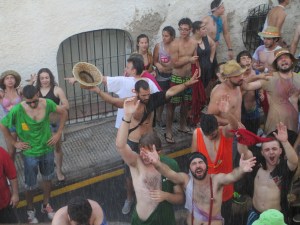
Waiting to be doused with water at Sant Joan festival in Altea
Sant Joan Festivals are very popular in Spain, particularly in the Province of Valencia where I live, as well as in Catalan-speaking areas, and Galicia. Sant Joan is the Valenciana and Catalan languages way of saying Saint John. The Sant Joan festival in Alicante is Spain’s largest, and one of Alicante’s most important festival. The festivals occur around June 23, the day of Sant Joan, typically with numerous days of activities that vary with the location.
In Alicante, there are large “Ninot” characters that are set on fire, much like the famous “falles” festival in Valencia in March. The Ninot are amusing parodies of famous people or politicians made of wood, cardboard, mud, and other items. This year’s Alicante festival occurs for four days. There are noisy early morning (for Spain) wake-ups, parades, costumes, music and many more activities.
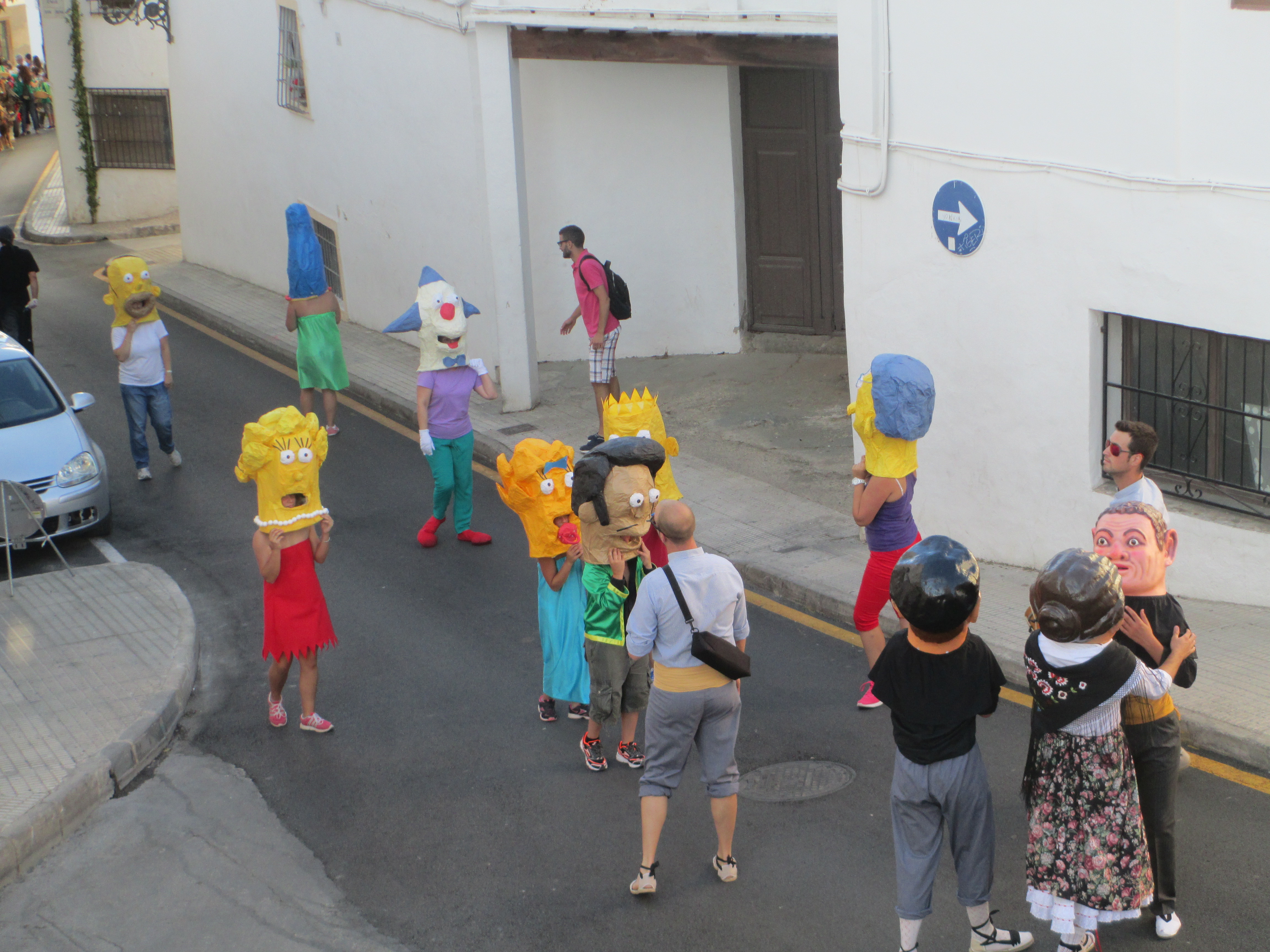
Sant Joan parade with masks
In my town of Altea, when I first heard about the impending festival, I had no idea what to expect. My initiation to the festival was the booming fireworks midday, followed later by a parade of locals with cartoon character heads. There have been three early morning wake-ups by noisy participants yelling, playing instruments, and more fireworks. My apartment is on the street where all the local parade participants go as they head up the hill to the cathedral in Altea’s main plaza. One afternoon, there was a huge pan of traditional paella cooked in the plaza for all to sample. One midnight during the festival, people wade into the ocean. After all, St. John is remembered for baptizing Jesus.
This festival requires stamina. The first group of parade participants, which included many musicians, continued to march and perform for more than 12 hours. During the second afternoon parade, the noisy participants of all ages wore torn t-shirts and were soaking wet as they made their way up the hill. There were two groups, each carrying a tall tree, many drinking from large jugs or other vessels of wine, while the people watching on from their apartments above dump and spray water on the giddy participants.
Raising the tree
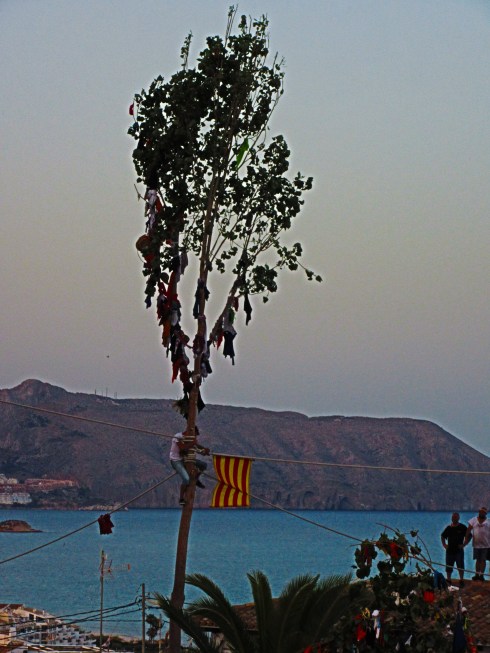
Once done with the procession, in the plaza the trees are hoisted to stand erect. Men attempt to climb the tree as high as possible onto the unstable trees to tie on their ripped t-shirt. An ambulance was waiting nearby for anyone who might fall. However, I think it is nearly as dangerous for the women who wear spindly high heel shoes while walking on the uneven, rocky plaza surface, or dancing when the late night band plays.
Climbing the tree to tie on a flag
Today, Sunday, parade participants wore traditional costumes while trekking up the hill to the accompanying music followed by a “solemn” mass. There are numerous activities scheduled including more music processions. (Altea music schools for youth and a professional school for adults so music is always a prominent part of any festival.) There will be more fireworks, and in the plaza another giant communal paella, and disco music starting at 11:00 p.m.
What has been your favorite festival experience in Spain?
A Fulfilling, Less Stressful Life Running an Artsy Bar in Idyllic Altea Spain
7 JunSara and David at their artsy bar in Altea
In the same week, Sara Wilson lost her job as a staff writer for a major business magazine, and her husband, David Fernandez, lost his position as a private chef for socialites in New York City. They used that as a springboard to “re-examine our careers and quality of life.” They originally met in France, married and moved to California, then to New York to further their careers. Even though they liked certain aspects of living In New York, their lives were stressful, too money driven, and they didn’t get to spend much time together. Sara reflected, “Life gave us solution when we got laid off within a week of each other.” After considering their options, they initially decided to move to more relaxed Spain with the idea of opening a restaurant with David’s father. When that didn’t work out as anticipated, Sara and David started exploring other options, and eventually settled on opening a bar and eatery.
Sara reported, “My six years at the magazine job interviewing entrepreneurs helped us in the process of starting our business.” She added, “Ironically, I learned from people’s stories and their tips for success.” David had previously completed culinary training in Paris. She noted, “David is more of a visionary and risk-taker than I am, but it was our joint talents that helped us develop a successful business.”
Picturesque and historic Altea
They spent several months exploring towns in the Costa Blanca area along the Mediterranean. They briefly looked at touristy Benidorm, but it did not possess the attractive and friendly location they were seeking. Then, “Unexpectedly we encountered a village paradise…called Altea,” recalled Sara. “We loved Altea’s stunning coastline, white pebble beaches and inviting and tasty restaurants lining the promenade.” But it was when they entered the old town, once a fortress, that they were really “awestruck. We loved its picturesque, narrow, pedestrian streets, punctuated by small artisan shops, that lead up to the hilltop church plaza.” Thus they set about on finding a place in the old town, known as Casco Antiguo.
Not long thereafter, they found an apartment and a place to start their dream business, a café/bar which was promoting various forms of art. “The rent was the cheapest we had found, and was the right size for just the two of us to run.” It consisted of two floors that had been transformed from an old house. We liked the fact that it had a mezzanine, a decent stock room, it was just one street down from the church plaza, and was on one of the most charming streets of Altea.” The business had been operating primarily as a sports bar, with a focus on the arts, as well, hence the name AlteArte. Importantly, “The bar already had a local clientele.”
They bought the business, but not the building. Sara stated, “We had been warned that it was important that the business have an existing business license. Just as we were ready to finalize the purchase, we learned that AlteArte did not have a business license.” The owner had applied for it and it was reportedly in process for a substantial period of time, (not unusual with the Spanish bureaucracy), but it had never been completed. Once the owner was aware that this unresolved issue was holding up the sale, the license was quickly approved. Sara and David speculated that the business license application was likely languishing with the local authorities, and that the owner, who was a local native, got the process completed quickly. Sara said, “It helped to buy a turn-key business, with an established clientele.” The prior owner, who sold them the business, wanted Sara and David to be success, and was supportive in a variety of helpful ways.
Typical evening with friends at AlteArte
Sara and David “wanted to change the ambience to a cozier environment, which we did by adding tables and changing some of the décor.” They later hung their now iconic multi-colored bicycle upside down from the ceiling, and added some other kitschy design elements. They provide Wi-Fi, and show major soccer matches (“fútbol”). “By changing things, we lost some of the former clients but gained others.” During their first year in business, they were often complimented on their tasty mojitos, so they decided to make that a focus. They setup an increasingly growing mojito menu, and identified AlteArte as a “mojiteria,”which set it apart from the other bars. They also make “nojitos,” alcohol-free mojitos. Adapting to client demonstrated preferences, “We abandoned our early idea of making it a coffee-centric business, instead focusing on our excellent selection and preparation of teas,” in addition to other typical bar beverages. Although their service focus is primarily on beverages, they also have a small selection of tapas and quesadillas, the latter being a popular, but rare item in Altea.
Casco Antiguo in Altea
Asked if they have encountered any problems or challenges in setting up their business, they reported initially the neighbors complained about noise and the tables and chairs they had placed on the stairs adjacent to their building. “Eventually, we were able to make peace with the neighbors, after convincing them that we would keep the noise down, and not cause them any problems.” During the slow time of year, they do minor renovations to AlteArte, but they noted it is hard to find qualified people who complete the work in a timely fashion. After deciding to start their business in Altea, Sara quickly began learning Spanish, something she felt essential in running their business.
The owner of their building had been renting out the top floor to various people as a shop with touristic and artisan items, but after a series of several failed businesses there, he asked Sara and David if they were interested in adding the top floor to AlteArte. “We decided to take this opportunity to expand. The top floor is primarily for special events and gallery exhibits, as well as weekly intercambio (Spanish English language exchange.)” AlteArte exhibits “one or two artists’ works each month.” The middle floor is an inviting area with pillows and populated with board games.
“The customers, new and old, shaped AlteArte’s atmosphere by natural evolution.” They have about an equal percentage of local and expat customers, with “most ex-pats in this area of the Costa Blanca area of Spain being Scandinavian.” In the beginning, most of their clientele came through word of mouth and Facebook. After opening the gallery on the third level, we reached out to local newspapers and magazines to promote those events.”
After they first opened in February 2010, Sara and David ran the business by themselves. “During our second and third summer, we hired our first employees. In our fourth year of operation, we hired Emily as our first full time employee. She had been a patron, and she had a good work track record of seven years at one local restaurant.” They emphasized it is very important to check out the reliability and work history of potential employees in Spain as there are generous laws favoring them, such as being allowed substantial sick leave just after being hired. A few months later, they hired another young woman, Ampy, full-time. Both employees are friendly, competent, and able to communicate with the clients regardless of what language they speak. “We pay them a little more than the typical local wage, and uncommonly, we also give them one day off a week including during the busy summer months.”
Sara and David inside AlteArte
When asked about other start-up or ongoing expenses or requirements, “there was an initial food safety course, basic business insurance, and nominal annual taxes.” They have not had any tax liability in the United States based on their Spanish net income. “We recommend using a gestoria,” which is a person whose task is to deal with the idiosyncrasies of Spanish government departments, for paying complex fees and taxes. “We receive an annual visit from the health department to check for correct refrigerator temperature and proper sanitation.” With regard to promoting AlteArte, “We have done some marketing by advertising our business in local tourist maps. Because we are in the Old Town, which is a steep, historically-protected area, we are not required to have handicap accessible facilities.” Sara reported, “AlteArte has allowed us to cover all of our expenses including the luxury of having two employees” which affords Sara the opportunity to spend long visits with her family in California. This year she has had two separate one-month visits with her family. AlteArte has given David, now 40, and Sara, 37, “a more comfortable, and significantly less stressful lifestyle than at our prior high pressure jobs, and the opportunity to spend more quality time together.”
When asked what advice they would give to others considering opening a business in Spain, they recommend, “Be patient and committed.” They said, “One cannot expect to open a business just for a summer, and turn a profit.” They also stated it is important to understand the demand for the type of business one is considering, and the required permits if starting from scratch. “It is also essential to have enough capital for start-up costs, slow periods, and unexpected expenses.” Sara said, “I’m kind of glad I didn’t know before we started how many businesses end up closing down.”
Now celebrating over six years of operation, AlteArte, is a favorite with local ex-pats, Spaniards, and international travelers. They feature monthly art exhibits by local artists; a book club for which Sara often arranges for the author to be present in person or remotely; live music; weekly Spanish-English language exchange (intercambio); movie nights, craft, drama and dance workshops, cooking competitions, and many more. Asked about her most cherished memory, Sara quickly reported it was when director Eugenio Mira, an Altean native, chose to premier his movie Grand Piano at AlteArte, and afterwards had a question and answer session.
Retiring to a Fun, Inexpensive, Quality Life
20 Mar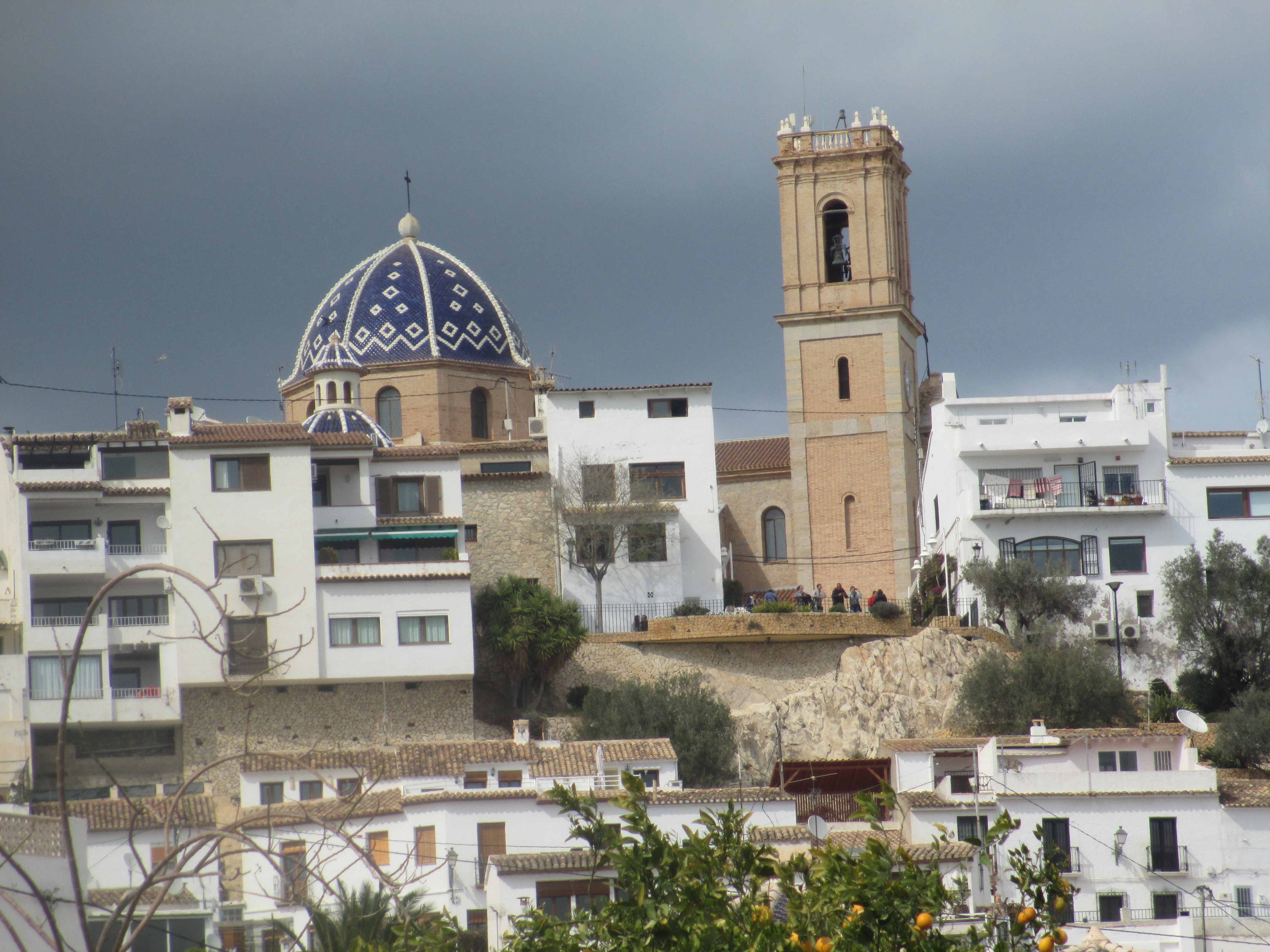
Altea on a rare cloudy day
Today I got up at the crack of noon. It’s not something I do every day, but it is a luxury I relish after those late Spanish nights out with friends. Yesterday, I had two Norwegian friends over to my house for a traditional American dinner, something they asked if I would do. Here in Altea, in the Costa Blanca area of central Mediterranean Spain, it is sometimes difficult to source some typical American food ingredients, but it makes for a fun challenge. When I wanted to make authentic Jamaican Jerk chicken and could not find habañero peppers, David, a chef and co-owner of my favorite local bar, AlteArte, volunteered to buy some for me at a commercial food market for restaurants. AlteArte is a local mojiteria (bar specializing in making mojitos) and arts bar.
After our American dinner, Daniel, one of my invited guests, was hosting his monthly movie night at AlteArte, so we took the short walk to it in the center of the historic old town at the top of the hill. We stayed late enjoying the busy, convivial atmosphere. The prior week Daniel had me to his house for a traditional Norwegian dinner. Both he and his roommate each created their unique regional specialty dishes. Being from north of the Arctic Circle, Daniel’s dish was roast pork with crackling skin. Delicious! I love the opportunities to meet new friends with whom I can exchange our different cultural traditions. Another particularly memorable experience I have had was when a Nepalese family invited me to their house for a delicious, homemade meal at their home. It was my first time eating traditional, homemade Nepalese food, and afforded me the opportunity to get to know more about their lives and culture in Nepal.
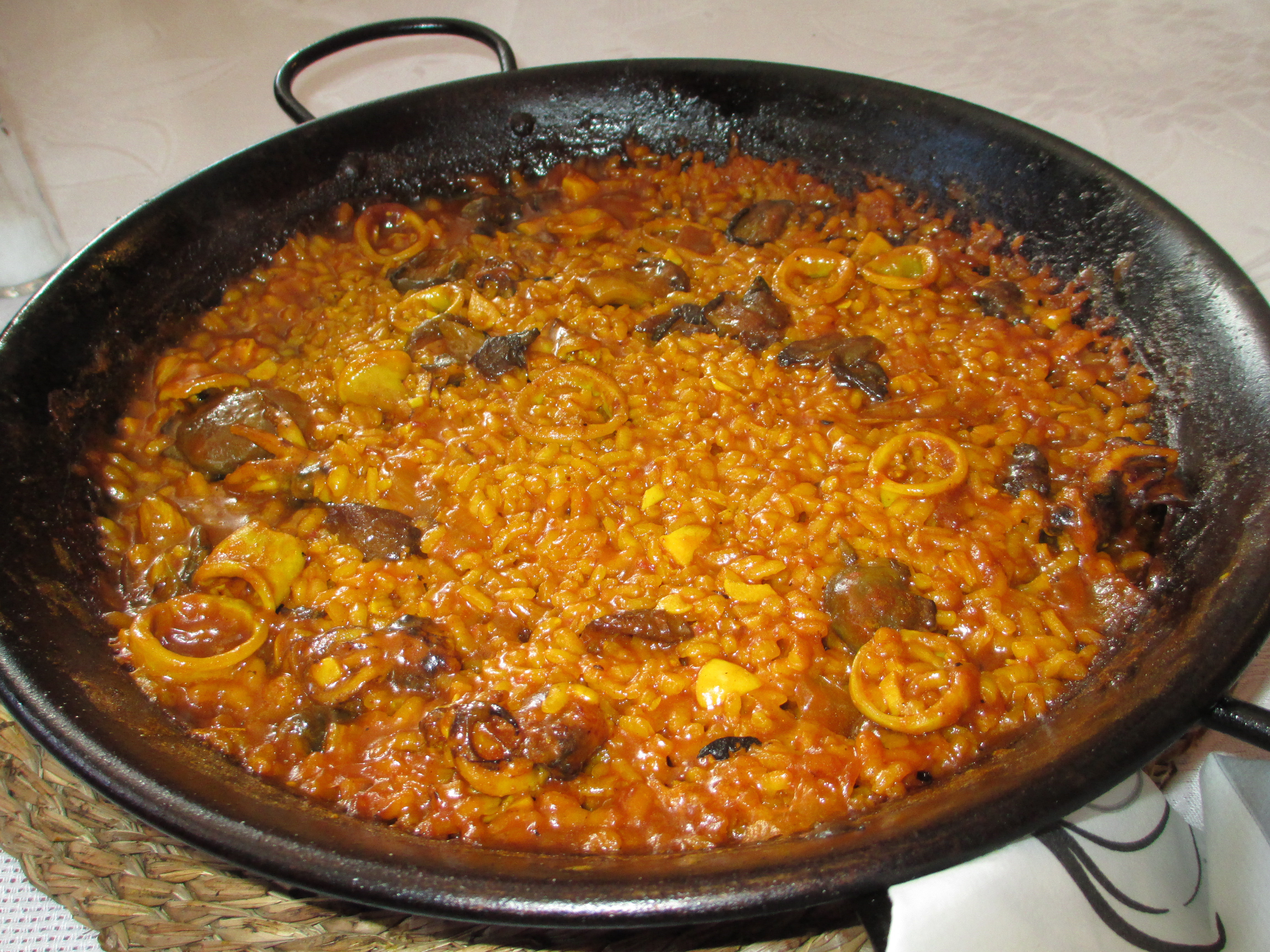
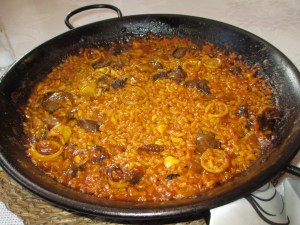
Seafood paella
There are always challenges when trying to re-create and share American traditions to my friends in my new home country, Spain. However, mostly I embrace the new cultural and food customs here. Jamones (various types of ham and pork products) are a Spanish favorite, served simply as thin slices or often as an ingredient in many dishes, like steamed clams with pieces of ham. I have even found ham in the usually vegetarian gazpacho blended soup and in steamed clams. There is an incredible bounty of fresh fish and seafood from the local Mediterranean. I enjoy spontaneous daily forays to local bars where, in the evening, I get a free tapa with my glass of wine for as little as 1, 20€ ($1.32.) Inevitably, I encounter friends with whom I enjoy genial conversation.
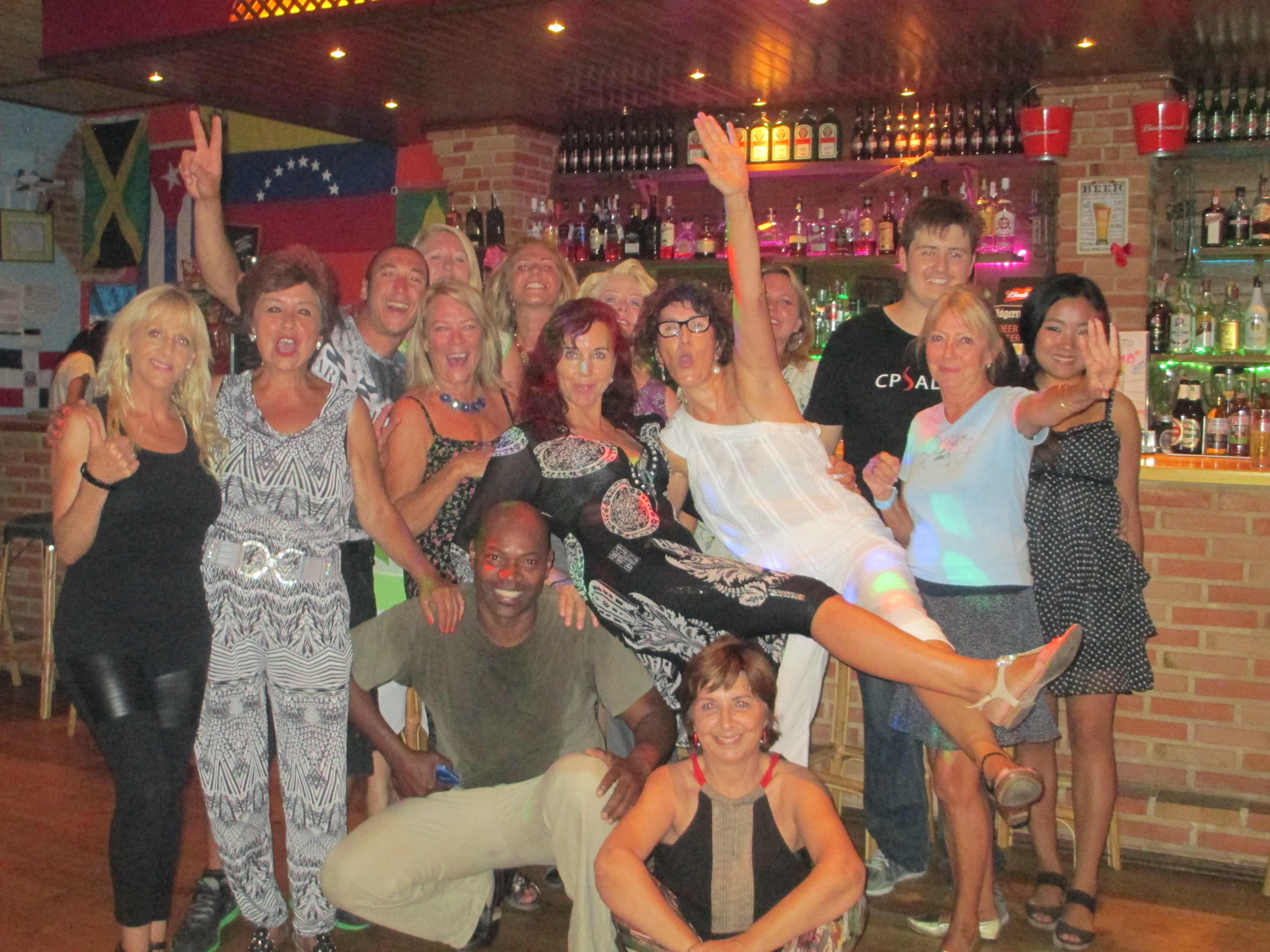
Bar Cuba
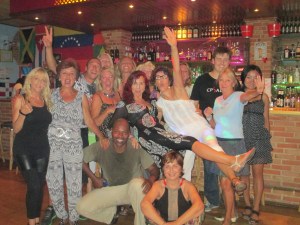
Although I was an avid live music fan when I lived in the Central Coast of California, here in Altea Spain, there are many diverse activities, including the many regional Spanish festivals, live music, in addition to the time spent celebrating new cultural experiences with friends. One of my regular favorites is going with friends to Bar Cuba, for salsa and other types of Latin dancing to live music by Rafa, a friend who is originally from Venezuela. Bar Cuba is co-owned by Raúl and Nikki; Nikki is a friendly, competent businesswoman who originally hails from Jamaica. Other nights she schedules salsa and other Latin dance classes, karaoke, televised soccer games (fútbol), and specialty international dinners. Living in Spain allows me to enjoy traditional Spanish festivities, as well as experience cultural experiences from the variety of ex-pats who live here.
With the low cost of living in the Costa Blanca, I no longer have to work, and can focus on friends and fun. The Spanish are known for their many festivals, which offer spectacle and fun. Where I lived in California, it was nearly impossible to function without a car.

Moros y Cristianos festival
Here in Spain, I relish no longer having to have a car. I walk to all of my local activities, or take convenient, efficient, inexpensive public transportation to nearby towns, with unexpected health benefits. Instead of finding it difficult to even arrange a short monthly get together with a friend in California, here in Altea, rarely does a day go by where I don’t meet up with friends, whether planned or spontaneous. It is sometimes hard for me to believe that I live in one of the most beautiful villages in Spain, with such an inexpensive cost of living, and fulfilling quality of life.
Quirky and Different Customs in Spain
6 FebI love my new life in Altea Spain. However, there are some quirky and unexpected things which I have encountered or needed to adjust to.
I recently read that when local children were enacting a bull run using toy wooden bulls that this year they would not be allowed to have the bulls’ horns lit on fire during the run. Apparently this was perfectly fine in prior years.

Tree on which people climb to tie on their t-shirt at the St. John festival
During the many Spanish festivals, people sometimes engage in dangerous behavior. At the local St. John festival, participants carry a tree to the church plaza while encouraging observers to throw water on them. Once in the plaza, they pull the spindly tree to a vertical position and fueled with alcohol attempt to make the perilous climb to the top. What I found particularly interesting was the ambulances that were waiting just a few feet away. One has only to think of the running of the bulls in Pamplona for another example. Or the “baby jumping” festival near Burgos, where people in costumes jump over a mattress on which lie babies born in the prior 12 months. This ritual serves to rid the babies of evil spirits and guard against illness.
As I have mentioned in prior posts, dealing with the Spanish bureaucracy is nearly always fraught with difficulties, often because what you are told you need to do changes with successive visits. Similarly, I have had my rental cars towed two of the four times I rented them. In one case, I parked in a handicapped spot and put up my disabled placard. When I returned to retrieve the car, it was gone. When I contacted the local police, they informed me I had parked in a handicap spot reserved for a specific car, as indicated by the numbers on the handicap parking sign. I said I have travelled to and driven in many countries, and have never seen handicap spots for specific vehicles. I received a blank look, and was told I had to fork over around $150 to get the car out of impound.
I have also previously mentioned the multiplicity of problems I have had in receiving packages sent from the U.S. One box arrived gaping open, with items missing. Then the postman asked me to help carry it because it weighed a lot. Another box of household items was twice returned to my son, first because I declared there was no monetary value to items which were only sentimental, and the second because they did not see the documentation that I had submitted the nearly 100 Euros customs fee. I have been trying unsuccessfully for more than two months to get a refund for that, and there is no chance of getting a refund on for the hundreds of dollars I spent in having the box mailed here twice.
The sidewalks in my village are made of attractive, but incredibly slick tiles, especially when wet. It is so precarious that people typically walk in the road when it rains. I see many more people here with arms and legs in splints or casts, which I would bet is related to the falls people have. I have jokingly suggested that maybe the tile sidewalks were the idea of the local orthopedic physicians.

Moros Y Cristianos festival 2015 in Altea
The Spanish definition of opening early means 9 or 10 in the morning. Such opening times are understandable in light of the lengthy afternoon siesta, and businesses and meals occurring late at night. Often when businesses close for several weeks or months, there is no sign informing the would-be patron of the closure. Nor are there websites for businesses which provide that information. Businesses including grocery stores are closed for national and local holidays, which can sometimes last several days. After the several day local Moros y Cristianos (Moors and Christians) festival, all businesses were closed for the day, not for the holiday but for a day for people to recover from the festival. After four days of festivities and drinking starting at 8 or 9 in the morning, and ending around 4 a.m., they need a recovery day.
I find Spanish people generally genial, and polite. They always greet you when you enter their business. In their vehicles, they are very good at stopping for pedestrians at crosswalks. However, when walking, they may suddenly cut right in front of you or stop and block the sidewalk while conversing. When picking up my dog’s excrement from the sidewalk, I have had people step over my head, and roll over my foot with a stroller.
Sometimes there are what seem to be arbitrary rules. When we recently went to a high end musical and dance variety show which featured a choice of two dinner menus, we were told everyone in our group had to order the same menu. Otherwise, we would be placed at separate tables based on our dinner choice.
Have you ever encountered unexpected behaviors/customs while living in or travelling to a new country?
Connect with Me


 Starr Treks