
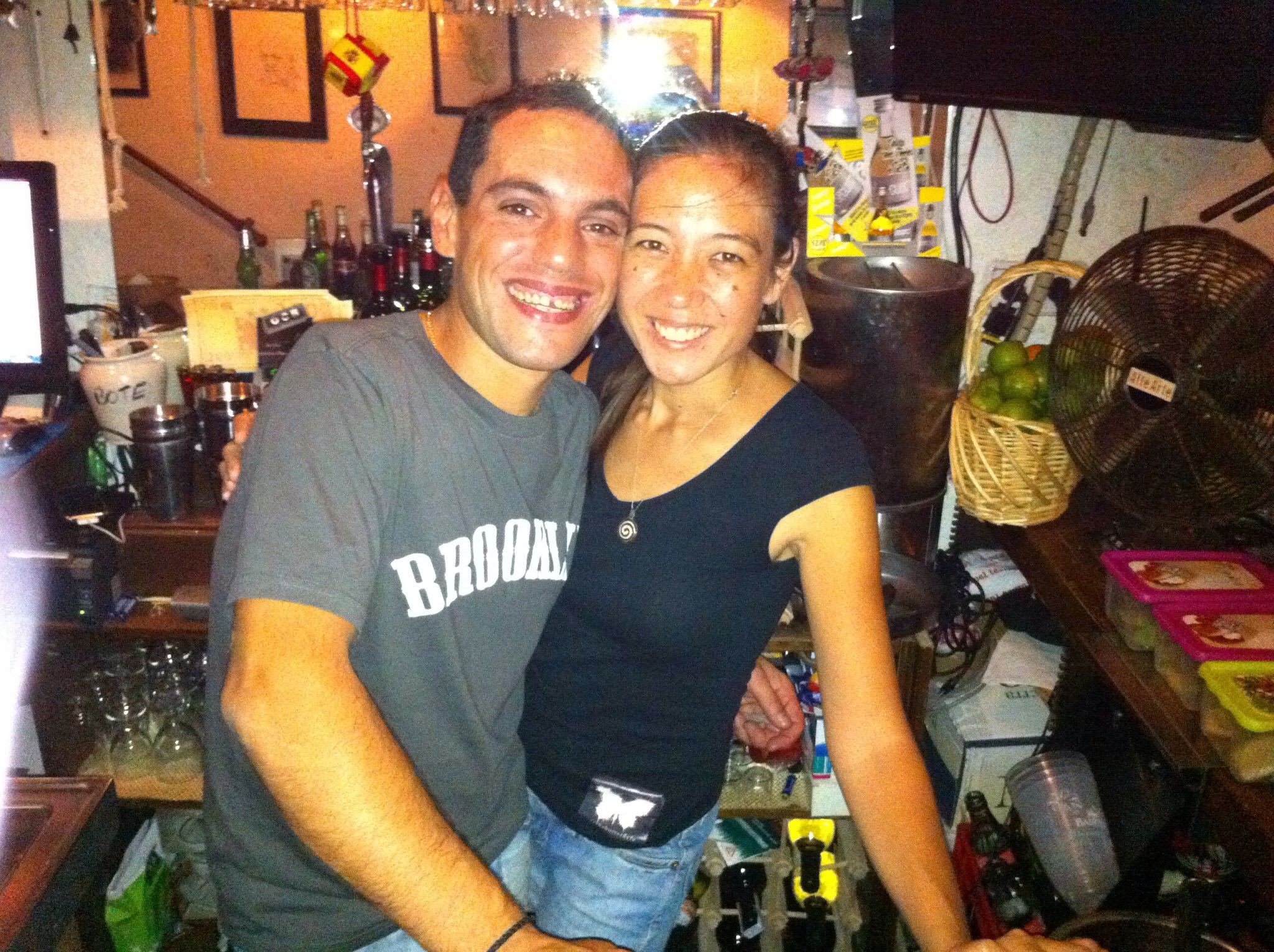
Sara and David at their artsy bar in Altea
In the same week, Sara Wilson lost her job as a staff writer for a major business magazine, and her husband, David Fernandez, lost his position as a private chef for socialites in New York City. They used that as a springboard to “re-examine our careers and quality of life.” They originally met in France, married and moved to California, then to New York to further their careers. Even though they liked certain aspects of living In New York, their lives were stressful, too money driven, and they didn’t get to spend much time together. Sara reflected, “Life gave us solution when we got laid off within a week of each other.” After considering their options, they initially decided to move to more relaxed Spain with the idea of opening a restaurant with David’s father. When that didn’t work out as anticipated, Sara and David started exploring other options, and eventually settled on opening a bar and eatery.
Sara reported, “My six years at the magazine job interviewing entrepreneurs helped us in the process of starting our business.” She added, “Ironically, I learned from people’s stories and their tips for success.” David had previously completed culinary training in Paris. She noted, “David is more of a visionary and risk-taker than I am, but it was our joint talents that helped us develop a successful business.”

Picturesque and historic Altea
They spent several months exploring towns in the Costa Blanca area along the Mediterranean. They briefly looked at touristy Benidorm, but it did not possess the attractive and friendly location they were seeking. Then, “Unexpectedly we encountered a village paradise…called Altea,” recalled Sara. “We loved Altea’s stunning coastline, white pebble beaches and inviting and tasty restaurants lining the promenade.” But it was when they entered the old town, once a fortress, that they were really “awestruck. We loved its picturesque, narrow, pedestrian streets, punctuated by small artisan shops, that lead up to the hilltop church plaza.” Thus they set about on finding a place in the old town, known as Casco Antiguo.
Not long thereafter, they found an apartment and a place to start their dream business, a café/bar which was promoting various forms of art. “The rent was the cheapest we had found, and was the right size for just the two of us to run.” It consisted of two floors that had been transformed from an old house. We liked the fact that it had a mezzanine, a decent stock room, it was just one street down from the church plaza, and was on one of the most charming streets of Altea.” The business had been operating primarily as a sports bar, with a focus on the arts, as well, hence the name AlteArte. Importantly, “The bar already had a local clientele.”
They bought the business, but not the building. Sara stated, “We had been warned that it was important that the business have an existing business license. Just as we were ready to finalize the purchase, we learned that AlteArte did not have a business license.” The owner had applied for it and it was reportedly in process for a substantial period of time, (not unusual with the Spanish bureaucracy), but it had never been completed. Once the owner was aware that this unresolved issue was holding up the sale, the license was quickly approved. Sara and David speculated that the business license application was likely languishing with the local authorities, and that the owner, who was a local native, got the process completed quickly. Sara said, “It helped to buy a turn-key business, with an established clientele.” The prior owner, who sold them the business, wanted Sara and David to be success, and was supportive in a variety of helpful ways.

Typical evening with friends at AlteArte
Sara and David “wanted to change the ambience to a cozier environment, which we did by adding tables and changing some of the décor.” They later hung their now iconic multi-colored bicycle upside down from the ceiling, and added some other kitschy design elements. They provide Wi-Fi, and show major soccer matches (“fútbol”). “By changing things, we lost some of the former clients but gained others.” During their first year in business, they were often complimented on their tasty mojitos, so they decided to make that a focus. They setup an increasingly growing mojito menu, and identified AlteArte as a “mojiteria,”which set it apart from the other bars. They also make “nojitos,” alcohol-free mojitos. Adapting to client demonstrated preferences, “We abandoned our early idea of making it a coffee-centric business, instead focusing on our excellent selection and preparation of teas,” in addition to other typical bar beverages. Although their service focus is primarily on beverages, they also have a small selection of tapas and quesadillas, the latter being a popular, but rare item in Altea.
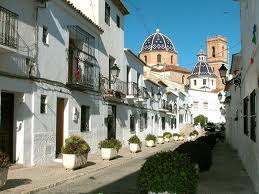
Casco Antiguo in Altea
Asked if they have encountered any problems or challenges in setting up their business, they reported initially the neighbors complained about noise and the tables and chairs they had placed on the stairs adjacent to their building. “Eventually, we were able to make peace with the neighbors, after convincing them that we would keep the noise down, and not cause them any problems.” During the slow time of year, they do minor renovations to AlteArte, but they noted it is hard to find qualified people who complete the work in a timely fashion. After deciding to start their business in Altea, Sara quickly began learning Spanish, something she felt essential in running their business.
The owner of their building had been renting out the top floor to various people as a shop with touristic and artisan items, but after a series of several failed businesses there, he asked Sara and David if they were interested in adding the top floor to AlteArte. “We decided to take this opportunity to expand. The top floor is primarily for special events and gallery exhibits, as well as weekly intercambio (Spanish English language exchange.)” AlteArte exhibits “one or two artists’ works each month.” The middle floor is an inviting area with pillows and populated with board games.
“The customers, new and old, shaped AlteArte’s atmosphere by natural evolution.” They have about an equal percentage of local and expat customers, with “most ex-pats in this area of the Costa Blanca area of Spain being Scandinavian.” In the beginning, most of their clientele came through word of mouth and Facebook. After opening the gallery on the third level, we reached out to local newspapers and magazines to promote those events.”
After they first opened in February 2010, Sara and David ran the business by themselves. “During our second and third summer, we hired our first employees. In our fourth year of operation, we hired Emily as our first full time employee. She had been a patron, and she had a good work track record of seven years at one local restaurant.” They emphasized it is very important to check out the reliability and work history of potential employees in Spain as there are generous laws favoring them, such as being allowed substantial sick leave just after being hired. A few months later, they hired another young woman, Ampy, full-time. Both employees are friendly, competent, and able to communicate with the clients regardless of what language they speak. “We pay them a little more than the typical local wage, and uncommonly, we also give them one day off a week including during the busy summer months.”
When asked about other start-up or ongoing expenses or requirements, “there was an initial food safety course, basic business insurance, and nominal annual taxes.” They have not had any tax liability in the United States based on their Spanish net income. “We recommend using a gestoria,” which is a person whose task is to deal with the idiosyncrasies of Spanish government departments, for paying complex fees and taxes. “We receive an annual visit from the health department to check for correct refrigerator temperature and proper sanitation.” With regard to promoting AlteArte, “We have done some marketing by advertising our business in local tourist maps. Because we are in the Old Town, which is a steep, historically-protected area, we are not required to have handicap accessible facilities.” Sara reported, “AlteArte has allowed us to cover all of our expenses including the luxury of having two employees” which affords Sara the opportunity to spend long visits with her family in California. This year she has had two separate one-month visits with her family. AlteArte has given David, now 40, and Sara, 37, “a more comfortable, and significantly less stressful lifestyle than at our prior high pressure jobs, and the opportunity to spend more quality time together.”
When asked what advice they would give to others considering opening a business in Spain, they recommend, “Be patient and committed.” They said, “One cannot expect to open a business just for a summer, and turn a profit.” They also stated it is important to understand the demand for the type of business one is considering, and the required permits if starting from scratch. “It is also essential to have enough capital for start-up costs, slow periods, and unexpected expenses.” Sara said, “I’m kind of glad I didn’t know before we started how many businesses end up closing down.”
Now celebrating over six years of operation, AlteArte, is a favorite with local ex-pats, Spaniards, and international travelers. They feature monthly art exhibits by local artists; a book club for which Sara often arranges for the author to be present in person or remotely; live music; weekly Spanish-English language exchange (intercambio); movie nights, craft, drama and dance workshops, cooking competitions, and many more. Asked about her most cherished memory, Sara quickly reported it was when director Eugenio Mira, an Altean native, chose to premier his movie Grand Piano at AlteArte, and afterwards had a question and answer session.
Tags: Altea, Altearte, art, California, Casco Antiguo, Chef, EugenioMira, France, Grand Piano, Intercambio, movie nights, Multicultural friends, Music, New York, Opening business in Spain, Private chef, Quality of life, Spain, Spanish food, Tapas, Work stress, Workshops






 Starr Treks