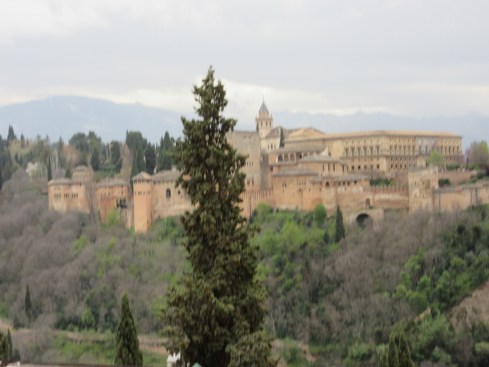
The Alhambra
As previously arranged, the last Muslim ruler in Spain, Boadbil, reluctantly handed over the key to the spectacular Alhambra to the Spanish monarchy on January 1, 1492. No matter how much I have read about the Alhambra, I was still gobsmacked by it, from its size and beauty, intricate carvings, water features, gardens and the overall grand, but tranquil, enchanting ambience. By 1238, with the taking of Cordoba from the Moors, the Spanish “Reconquista” had regained all of Spain with the exception of Granada. Under a peace agreement with the Spanish monarchy, Granada flourished. Under Moorish rule, the site of the Alhambra was used as a fortress, and in the 13th century the Nasrid Dynasty began building the Alhambra complex. Any attempt to provide an accurate portrayal of the Alhambra will be woefully inadequate in describing its unique architecture and beauty. The Generalife, the nearby country gardens and buildings on the Alhambra’s northern area are perched higher, resulting in a cooler, inviting respite for the Nasrid rulers and their associates. A view of the snow-capped Sierra Nevada, Spain’s tallest mountain range, can be enjoyed from the Generalilfe. I recommend the tour of both the Alhambra and Generalife, which takes around 4 ½ hours. Be sure to purchase your tickets well in advance as tickets are often sold out, arrive early, and wear comfortable walking shoes and bring shade from the sun.

Palace of Charles V
After more than 250 years of rule under the Moors, King Fernando and Queen Isabel fought to restore Granada to Spain, which they succeeded in doing on January 1, 1492. The Alhambra was spared from the usual destruction and/or conversion to Christian buildings, which makes it a unique attraction. However, their grandson, Charles V, built a palace in the Renaissance style within the walls of the Alhambra, which makes for an odd, but interesting juxtaposition to the Moorish designs. This building houses museums of Spanish-Islamic Art and Bella Artes (Fine Arts.)

The Albaicín is the Moorish old city, which faces and provides one of the many fantastic views of the Alhambra. The Albaicín has a jumble of narrow streets and historic homes called Carmenes, the latter which consist of external high walls to provide privacy and internal fountains, patios and inviting living spaces. The Albaicín church of San Nicolas is a popular destination, and its plaza affords panoramic views. In the hills just above the Albaicín is the El Sacromonte, the caves where gypsies live and perform flamenco shows.
In 1523, work began on Granada’s Cathedral, which is massive and opulent, featuring both Gothic and Renaissance architecture created by a series of several architects during the 181 years during which it was constructed. It is one of the largest Cathedrals in Europe. It has a gold and white interior and features a circular capilla mayor (sanctuary) with five naves and multiple chapels. Its stained glass dome, large chorale books, and huge pipe organs are also noteworthy. Adjacent and joined to the Cathedral is the Capilla Real, the Royal Chapel, which was built for the royal monarchs between 1506 and 1521. It houses an ornate grille enclosing the altar and the marble sculptures of Fernando and Isabel, their daughter, Juana La Loca and her husband Felipe el Hermoso. Their coffins lay in the crypt below the marble figures. Both facilities offer works of famous artists.

Plaza Nueva is the oldest square in Granada, and a good place for a beverage, tapa and people-watching. One of my favorite spots is Bodega Catañeda, a rustic, authentic tapas spot for local jamones (hams), creative dishes, and sherry. There are many eateries serving authentic Moroccan and Arabic food. Granada is fairly compact, so walking or taking a cab are the best options for getting around.

Bodegas Castaneda
Since moving to Spain, I have happily taken advantage of the opportunity to explore the country’s diverse and unique attractions, including many UNESCO world heritage sites. For this special venue in Granada, I splurged and stayed at the 14th century Parador within the walls of the Alhambra. In Spain, a parador is a historic or scenic building which the Spanish government has converted into an inn or hotel. The parador at the Alhambra has been described as the best or one of the best in Spain. Queen Isabel and King Fernando were initially buried on the site, while the Royal Chapel was being built in Granada as their final resting place. The parador was a former monastery built on orders of the royal monarchs on a site which was originally a mosque. This parador provides an inviting, tranquil respite after exploring the Alhambra and the City of Granada, and its intriguing history and delicious local foods.


 Starr Treks